
Mr. K.C. Kailasam - 27 Jul 2026
The costliest decision on an interior fit-out rarely involves flooring, lighting, or furniture. It's the contract structure signed before any of that gets specified: whether one team is responsible for both design and construction, or two separate parties are. That single choice, more than any design decision that follows, decides your final budget, your move-in date, and who you call when something doesn't work. For a design build interior project specifically, where the space is occupied, leased, or running against a licensing deadline, that choice carries more weight than it does on a ground-up building, because the margin for schedule error is thinner.
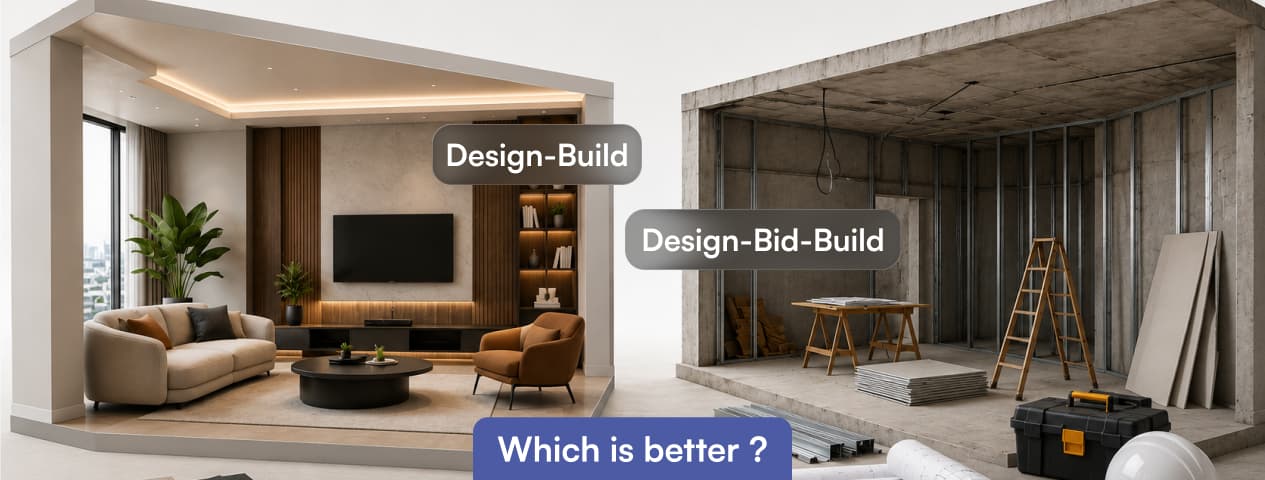
Every interior project runs on two parallel tracks: design decisions and construction decisions. A delivery method is the contractual arrangement that decides whether those two tracks are managed by one accountable party or two independent ones. It governs three things that determine almost everything else on the project: who is contractually allowed to price the work, when that pricing can happen relative to design progress, and who is on the hook when a detail doesn't translate cleanly from drawing to site. Two models dominate interior work: design-bid-build, the traditional sequence, and design-build, the increasingly common alternative for time-sensitive space.
Design-bid-build separates the two tracks completely. You hire an architect or interior designer who works only for you, with zero financial connection to whoever eventually builds the space. That designer takes the project through space planning, schematic design, and construction documentation until the drawings are complete enough for a contractor who has never walked the site to price accurately. Only then does the project go to tender, where competing general contractors bid the identical scope, typically over two to six weeks.
This structure exists to protect price discovery. Because the designer has no stake in construction cost, and multiple contractors price the same fixed drawings, DBB gives you the cleanest apples-to-apples comparison available. That's a genuine advantage on projects where design control matters more than speed: a heritage retrofit, a statutory tender, or a fully custom home interior where the owner wants a fixed, comparable price on an identical scope before committing capital, not a single relationship they have to trust blindly.
The limitation is timing. Nothing gets priced until the design is finished, so constructability, material lead times, and budget reality all surface late, after the drawings are already locked. If the winning bid lands over budget, which happens more often than owners expect, the design has to be revised and effectively re-bid, adding weeks to months before a wall comes down. The owner also becomes the default link between two parties who have no contract with each other, relaying RFI responses and adjudicating whether a field problem is a design error or a construction defect.
Design-build collapses the two tracks into one contract. The owner hires a single entity, a design-build firm, a contractor with an in-house design team, or a formal joint venture, and that entity is accountable for both the drawings and the finished product. There's no second contract and no separate designer to check its work.
The mechanism that makes this work is early contractor involvement. Because the same organization prices and designs at the same time, a ceiling height that conflicts with an existing duct run, or a stone finish with a fourteen-week import lead time, surfaces during design development, not after a completed drawing set gets bid. Pricing develops progressively, moving through firming estimates until it converges on a guaranteed maximum price, rather than arriving as one final number at the end of design.
The trade-off is trust concentration. You're not buying competitive pricing on a fixed scope, you're buying one team's judgment and internal quality control, which is a real limitation if that team is thin on design talent or field experience. Where it earns its advantage is procurement speed: because long-lead items, custom millwork, imported stone, specialty lighting, can be ordered the moment a material is selected and the budget confirms it fits, DB projects routinely start purchasing months before a comparable DBB project has even finished bidding. For a corporate office interior tied to a fixed lease commencement date, that compressed procurement window is often the single biggest reason the opening date holds. It's also close to what turnkey interior delivery promises: one accountable party, one contract, one number from concept to handover.
Most owners assume the schedule gap between these models comes from how fast the contractor can build. It doesn't. Framing, drywall, and MEP rough-in take roughly the same number of weeks regardless of delivery method. The gap comes almost entirely from procurement timing, and specifically from furniture, fixtures and equipment.
FF&E lead times routinely outlast construction itself. A custom-laminate conference table or an imported light fixture can carry a longer production timeline than the framing happening around it. In DBB, the contractor cannot legally commit to purchasing anything until a signed contract exists based on finished drawings, which means FF&E ordering often doesn't start until month seven of a six-month design phase. In DB, the same team can commit the moment a finish is selected and the number confirmed, sometimes months before documents are complete. Projects miss opening dates because a chair or light fixture arrived late far more often than because a wall took too long to build.
There's a second, less discussed difference: who is liable after handover. In DBB, if a ceiling grid conflicts with a light fixture six months into occupancy, resolving it means determining whether the fault traces to the design or the installation, two separate contracts, two separate insurers. In DB, one entity carries the defects liability obligation for the whole scope, which is why vetting a design-build firm's post-handover track record matters more than vetting a DBB architect's; there's no second party to fall back on if something goes wrong after you've moved in.
CII/Pankow research, conducted by the Construction Industry Institute with the Charles Pankow Foundation across 212 completed projects, found design-build delivered projects 102% faster from design through completion than design-bid-build, with 3.8% less cost growth, a gap driven almost entirely by this procurement head start, not by faster on-site construction.
India's own procurement framework recognizes this exact split, formally. The Central Public Works Department's Works Manual distinguishes between traditional item-rate contracts, functionally identical to DBB, and EPC or turnkey "Design and Construct" contracts, the DB equivalent, where one agency carries both. Public interior and infrastructure work still defaults to item-rate contracting in many cases, largely because statutory tendering rules require competitive price discovery on identical drawings, the same rationale that makes DBB attractive to private owners who want the same protection.
The cost of getting this coordination wrong at scale shows up in India's own infrastructure data. The Ministry of Statistics and Programme Implementation's Flash Report tracks every central-sector project worth ₹150 crore and above; its most recent reporting shows nearly 2,000 monitored projects carrying a cumulative cost overrun above ₹5 lakh crore, with delayed decisions and scope changes cited repeatedly among the causes. Interior fit-outs run at a fraction of that scale, but the mechanism is identical: decisions made late, after pricing is locked, cost more than decisions made early. That's the same structural problem design-build was built to reduce.
Most comparisons hand owners a long checklist. In practice, three questions do most of the work.
Is your opening date controlled by someone else? A retail store tied to a landlord's rent-abatement clock, or a restaurant with a hired kitchen staff and a liquor license application already in motion, cannot absorb a re-bid delay. That external deadline pressure is usually the single strongest signal toward design-build.
Do you want to price identical drawings against multiple contractors, or trust one team's judgment before design is finished? If competitive price discovery on a fixed scope matters more to you than speed, DBB is doing its job correctly, not failing to be design-build.
How much MEP and structural coordination does the space actually require? A shell-and-core retail unit with minimal ceiling and services work tolerates DBB's sequential process fine. A hospital or laboratory fit-out with dense mechanical coordination benefits disproportionately from having engineers, designers, and the construction team inside one organization from day one.
Neither model is a shortcut around bad project management. A poorly run design-build firm produces worse outcomes than a well-managed DBB team with a strong architect. What the delivery method buys you is a structure: one that either concentrates accountability in a single entity or spreads it across a competitively priced pair.
At R Space, we scope both models depending on what a project's timeline and risk tolerance actually demand. For clients looking for interior design services in Coimbatore, this approach helps us recommend a delivery method that fits the project's scope, schedule and level of coordination required. You can read more about our approach on our about page, or get in touch directly to talk through your project's deadline and scop
Is design-build cheaper than design-bid-build for interior projects?
On average, yes. CII/Pankow benchmark data shows design-build averaging 3.8% less cost growth than design-bid-build, largely because value engineering happens during design rather than after an over-budget bid comes in. Design-bid-build can still land at a lower headline number if competitive bidding drives contractor margins down, but it carries more risk of that number changing after the design is already locked.
Can you switch from design-bid-build to design-build partway through a project?
Rarely without cost. Once drawings are finished and out for tender under DBB, converting to a single-entity DB structure means re-contracting mid-process, which usually erases any procurement time already saved. This decision holds up best when made before the design phase starts, not after.
Is design-build allowed for government or public interior projects in India?
Yes, through EPC or turnkey contracts, which CPWD's own Works Manual recognizes as a distinct delivery path alongside traditional item-rate contracts. Many public projects still default to item-rate, DBB-style contracting because statutory rules require competitive price discovery on a fixed, finished scope.
What should I ask a design-build firm before hiring them for an interior project?
Ask for their defects liability track record after handover, not just their portfolio, since one entity carries both design and construction responsibility with no independent second party to catch its own mistakes. Also ask how they structure the guaranteed maximum price and at what design stage it gets locked.