
Mr. K.C. Kailasam - 21 Jul 2026
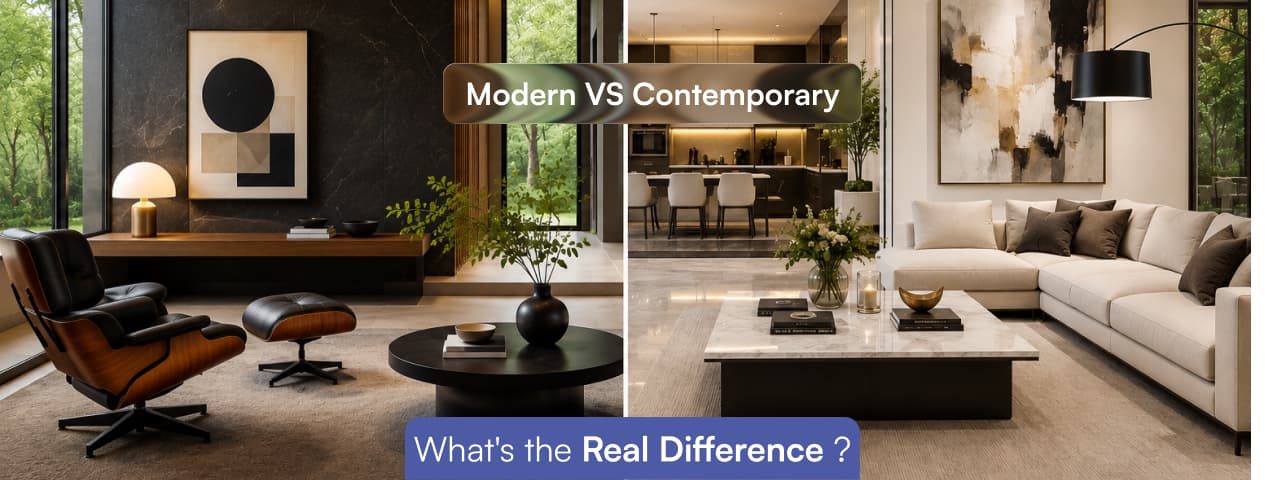
Almost everyone uses modern and contemporary interchangeably, and almost every showroom lets them. The two words describe different kinds of things. Modern is a closed historical style with a fixed vocabulary you can point at. Contemporary is a pointer to whatever premium design is doing at this moment, so its content changes while the word stays the same. That difference is not academic. It decides whether your preference can be written into a contract and checked at handover.
What follows corrects the four assumptions that cause the most expensive confusion, then gives you a test that converts either word into something a project can actually be held to.
Modern is historical, and it has a start date. The Bauhaus opened in Weimar on 1 April 1919 under Walter Gropius, moved to Dessau in 1925 and to Berlin in 1932, and closed in 1933 after fourteen years (The Metropolitan Museum of Art). Its teachers scattered, and the ideas they carried became the foundation of what we now call modern design. The style continued developing through the mid twentieth century and then settled. When a designer says modern, they are referring backwards to a defined period, not forwards to something new.
Contemporary is a time reference wearing a style's clothing. It means the design language currently in favour, which is why a home described as contemporary in 2015 and one described as contemporary today share the label and very little else. Nothing about the word is stable. This is not a criticism of contemporary interiors, many of which are excellent. It is a warning about what the word can and cannot carry in a specification.
This is the most damaging of the four, because it pushes people away from a style that would suit them. The modern design was warm. It used timber heavily, it used cane and leather and textile, and it used colour with confidence. The austere white box that many people picture is closer to a later minimalism than to modern proper. If you have rejected modern because you thought it meant cold, you rejected the wrong thing.
Most well resolved homes are neither purely one nor the other. They run a modern structural language in the elements that stay, and let contemporary preferences sit in the elements that move. The section on specification below explains why that division works better than a compromise across everything.
Read the fourth row first. It is the one with practical consequences, and it is the row almost no comparison of these two styles includes.
The two are not competitors. They answer different questions about how settled you want your house to be.
Four other terms get used in the same conversation, usually as though they were interchangeable with the two above. They are not, and knowing where each one sits removes most of the remaining confusion.
Modernism describes the broader architectural and ideological movement. Modern interior design is its domestic expression. If someone uses modernism about a house, they are usually pointing at the architecture rather than the furniture.
Mid century modern is a phase within modern, not an alternative to it. It refers to the post war stretch most associated with the 1950s and early 1960s, and it is the part of modern culture that popular culture remembers most vividly.
Minimalist is a reduction strategy rather than a period. It can be applied to a modern interior or a contemporary one, and it describes how much is present rather than what vocabulary is being used.
Transitional is a deliberate midpoint between traditional and contemporary, and it is the most frequently used and least defined term in Indian showrooms. It is worth treating as a description of intent rather than as a specification.
Modern contemporary, which appears constantly in listings and brochures, is not a style at all. It is a hedge, and it usually means the writer wanted the reassurance of both words without committing to either. Treat it as a prompt to ask what is actually meant.
Here is the practical problem that style articles never reach. Interiors are delivered against documents. A drawing, a material schedule, a bill of quantities. Every word in those documents has to mean the same thing to the person who wrote it and the person who executes it, because at handover a third party has to be able to say whether what was promised was delivered.
Modern survives that test. It carries references. A tapered leg, a specific timber, a horizontal emphasis, a stated proportion. Two people can disagree about whether they like it and still agree about whether it is there.
Contemporary fails that test on its own. It points at a consensus rather than a specification, and consensus is not verifiable. This is the source of a particular and avoidable dispute, where a client says the result does not feel contemporary, and there is no document either side can appeal to. Nobody is lying. The word was never load bearing.
The fix is straightforward. Translate the word before you sign, using something like the following.
The left column is a mood. The right column is enforceable. The translation is the actual work of specification, and it should happen before pricing, not after.
There is a quiet assumption in most Indian interiors content that choosing modern means importing a mid century American or Scandinavian reference. It does not, and the alternative is both closer and better adapted. After independence, Jawaharlal Nehru invited Le Corbusier to design Chandigarh. Le Corbusier and his cousin Pierre Jeanneret first visited in 1951, and Jeanneret went on to spend fifteen years in India as chief architect on site, until 1965. The furniture developed for the city, including the chair now known internationally as the Chandigarh chair, was designed by Jeanneret alongside Eulie Chowdhury and other Indian designers (Victoria and Albert Museum).
The detail that matters for a South Indian home is what it was made of. Solid teak and local sissoo rosewood, with bamboo, cotton and cane seats and backs chosen for comfort in warm weather. It was produced as low cost furniture at scale, and it adapted a European modular logic to Indian timber, Indian craft and Indian climate. A home in Coimbatore reaching for modernity can reference a language that was resolved for this heat, in these timbers, by people working here, rather than one resolved for a Californian desert. For homeowners working with an interior design company in Coimbatore, this also means looking beyond visual references and considering how materials, lighting, ventilation and furniture choices respond to the local climate. Cane in place of a fully upholstered back is not a rustic gesture in this climate, it is a thermal decision that was made deliberately seventy years ago. For how this sits beside the region's older traditions, see traditional Kerala interiors. When adapting a style to a real Indian home, the broader planning matters as much as the style label itself. These interior design ideas for Indian homes cover how different styles can be translated across rooms, materials, layouts and everyday living requirements.
If you want your house to look deliberate in a decade without further spending, modern is the safer commitment, because it is anchored to a period rather than to a moment. If you enjoy changing things and expect to refresh every few years, contemporary will suit you and there is nothing wrong with that choice as long as it is made knowingly.
For most clients the productive answer is a division by permanence, and it is a specification decision rather than a taste decision. Elements that are manufactured, fixed and expensive to replace should carry the descriptor that can be verified. Elements that are loose, soft and cheap to change can carry the one that cannot.
Give the verifiable language to fixed joinery, flooring, ceiling design and built in storage.
Let the current language sit in upholstery, loose furniture, lighting fixtures, art and textiles.
Keep one shared palette across both, so the division reads as coherence rather than as two arguments in one room.
Applied depth on the modern side, including room by room treatment, is covered in modern home interior ideas. If you are still mapping the wider field of styles before narrowing to these two, start with the complete guide to interior design styles.
Modern refers to a fixed historical style from roughly the 1920s to the 1960s, with a defined vocabulary of proportion, timber and honest structure. Contemporary refers to whatever design language is current, so its content changes over time while the label stays the same. Modern looks backwards to a period. Contemporary points at the present.
Yes, and warmth is closer to the original than starkness is. Modern design used timber heavily, along with cane, leather and textile, and it used colour confidently. The cold white interior most people associate with the word belongs to a later minimalism. Choosing modern does not commit you to an austere room.
Modern tends to age more predictably, because it was never claiming to be current and therefore cannot stop being current. Contemporary interiors age according to what was in favour when they were specified. The risk is manageable if the current language is placed in elements that can be replaced without reopening joinery.
Yes, and most resolved homes do. The reliable method is to divide by permanence rather than by room, giving the fixed and manufactured elements the language that can be specified and verified, and letting loose and replaceable elements carry current preferences. A single shared palette across both keeps the result coherent.
Translate the style word into named materials, finishes, dimensions and reference images before pricing, and get that translation into the material schedule. If a descriptor in your documents cannot be checked by someone who was not in the conversation, it is a mood rather than a specification and it will not protect you at handover.
The difference between these two words is ultimately a difference in how much of your intention survives the journey from conversation to finished room. Modern arrives with a vocabulary attached. Contemporary arrives as an instruction to agree on one. Either can produce an excellent home, and the failure mode is the same in both cases: a word everyone nodded at and nobody defined. If you are working through this decision for a specific property, our home interior service can turn a reference image into a material schedule that both sides can hold each other to, with the manufacturing carried out in our own facility so the finish specified is the finish produced.