
Mr. K.C. Kailasam - 24 Aug 2026
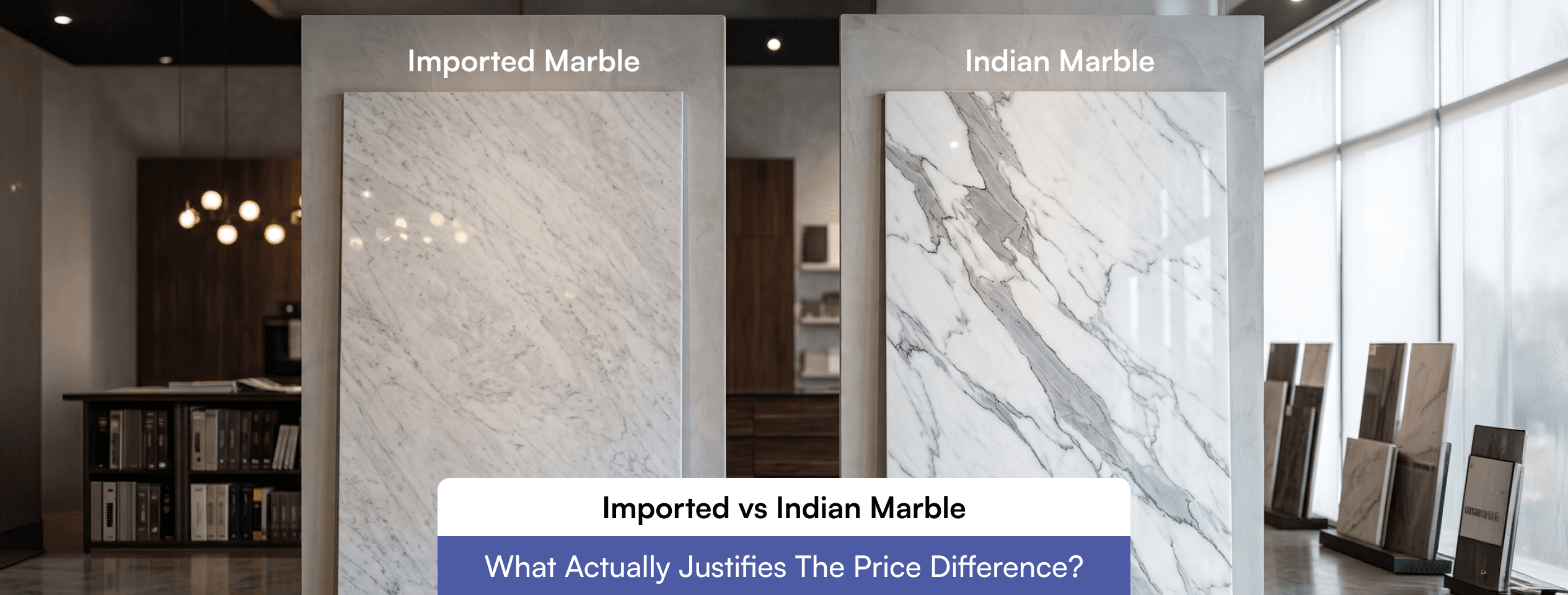
A client comparing two marble quotes for the same villa floor usually asks one question first. Why does the Italian slab cost three or four times more than the Makrana slab sitting right next to it in the same yard? The honest answer has very little to do with brand perception and almost everything to do with geology, block yield, and the distance a stone travels before it reaches a saw. Once you break the quote into its actual components, the price gap between imported and Indian marble stops looking arbitrary and starts looking like a set of decisions you can make deliberately, room by room. This piece is written the way we walk a client through material selection at R Space, starting from where the stone comes from, moving through what drives its landed cost, and ending with where each option genuinely earns its price. For a broader view of how marble compares with other premium finishes, our luxury interior materials guide is a useful companion. Indian marble is quarried, cut, and finished within the country, overwhelmingly in Rajasthan. According to the Indian Bureau of Mines, Rajasthan alone accounts for close to 89 percent of India's marble production, with Gujarat contributing most of the remainder. Towns like Makrana, Kishangarh, Rajsamand, and Ambaji are not just quarry locations, they are entire processing ecosystems with gang saws, polishing units, and a trading network built over generations. Imported marble, on the other hand, is quarried outside India, typically in Italy, Turkey, Greece, Spain, or Vietnam, and enters the country either as rough blocks that get cut locally or as finished slabs ready for installation. The country's total marble resource across all grades is estimated at 1,945 million tonnes (Indian Minerals Yearbook, Indian Bureau of Mines), which explains why domestic supply remains abundant and comparatively inexpensive even before you factor in transport. The distinction matters because it sets up every downstream cost. A block that never leaves Rajasthan skips ocean freight, customs duty, and import documentation. A block that starts in the Apuan Alps has to clear all three before it even reaches an Indian processing unit. Most articles stop at imported stone that costs more because it travels farther. That is true but incomplete. In practice, five factors stack on top of each other. Indian quarrying operates on a minor mineral royalty structure with relatively low extraction cost per tonne, especially in established belts like Makrana where infrastructure is already built. Italian and Turkish quarries carry higher labour and equipment costs, and land use regulations in Europe are considerably stricter than in Rajasthan's mining belts. This is the genuinely underreported part of the cost story. Recovery rate is the percentage of a raw quarried block that survives cutting to become sellable slab. Global best practice using modern diamond wire and computer-guided cutting achieves recovery rates of 40 to 45 percent. Indian quarrying, much of it still using older drilling and blasting methods, typically recovers only 20 to 25 percent of a block. In plain terms, for every tonne of raw Indian marble extracted, roughly three quarters becomes waste, offcuts, or unusable fragments before a single slab is polished. This is why some cheap Indian varieties are not actually cheap to produce, they are cheap to buy because raw material is abundant, not because the process is efficient. Larger, more consistent blocks from tightly controlled European quarries allow bigger slab formats with fewer joints. Indian slabs, particularly from smaller or older mining leases, are often cut in more conservative sizes to work around fissures, which increases the number of joints needed to cover the same floor area and adds labour time on site. Imported marble crosses at least one ocean and one customs border. It carries basic customs duty and IGST on landing, along with currency conversion risk between the quote date and the payment date. Indian marble carries none of this, only inland road transport from quarry to project site. Once you are in premium territory, price also reflects scarcity. Statuario and Calacatta blocks with minimal veining defects are genuinely rare even within Italian quarries, and pricing reflects that scarcity rather than production cost alone. This is the same logic that separates onyx marble from ordinary marble, translucency and pattern rarity command a price independent of where the stone was quarried. Makrana is the reference point for Indian marble and the source of the stone used in the Taj Mahal. The belt produces roughly 19.2 million tonnes a year across about 900 mines, employing close to 40,000 workers directly. Its calcitic composition, close to 98 percent calcium carbonate, gives it strong resistance to water absorption, which matters in Indian bathrooms and monsoon-exposed courtyards. Kishangarh functions less as a quarry and more as Asia's largest marble trading hub, where blocks from across Rajasthan and increasingly imported rough blocks are cut and finished before distribution nationwide. Rajsamand supplies off-white to greyish stone in high volume, and Ambaji in Gujarat contributes a further 10 percent of national output. Advantages worth knowing before you specify Indian marble on a project: Wide availability of matching stock, which matters years later if a slab cracks and needs replacing Strong performance against Indian heat and humidity without the sealing frequency imported stone often needs A mature fabrication ecosystem, meaning skilled masons and polishers are easy to find in most Indian cities Meaningfully lower landed cost, since there is no ocean freight, duty, or currency risk Limitations that a good project team should flag before booking material: Veining consistency across a large flooring area is harder to guarantee, since blocks from the same quarry can still vary lot to lot Micro-fissures are more common and are usually filled with epoxy resin during finishing, which is standard practice but worth knowing Large-format slabs beyond a certain size are less commonly available in domestic stock compared to premium imported blocks Italian marble remains the reference standard globally, sourced primarily from Carrara and the surrounding Apuan Alps. The tighter, more uniform metamorphic formation there produces marble with lower porosity and finer, more predictable grain than most Indian sources, which is why it holds detail so well in bookmatched applications. Pricing reflects that consistency. Italian marble at origin averages around €1,016 per tonne, compared to roughly $194 per tonne for Turkish marble, a gap that reflects quality tiering long before the stone lands in India. For a deeper look at how Italian marble compares against another popular imported option, our Italian marble versus travertine comparison covers that distinction in detail. Turkish marble occupies the mid tier, popular in large commercial fit-outs and hospitality projects where budget matters but imported provenance is still a requirement. Greek and Vietnamese quarries increasingly supply the onyx and specialty coloured stone used for backlit feature walls, a category where imported material has almost no domestic substitute. Advantages that justify choosing imported stone for specific applications: Larger consistent slab sizes, which reduce the number of visible joints on a floor or wall Tighter quality control at source, with fewer fissures needing epoxy repair Access to patterns, like true Calacatta veining or backlit onyx, with no comparable Indian equivalent Limitations worth planning around: Lead times of 8 to 12 weeks are typical from order confirmation to site delivery, longer if a specific block needs to be reserved and shipped Higher porosity in several Italian varieties means more frequent sealing in humid Indian climates Replacing a damaged slab years later usually means sourcing a fresh block, since matching an old imported lot exactly is difficult Ranges vary by city, vendor, and finish, but a realistic band for mid-to-premium residential work looks like this. Indian marble typically runs from around 60 to 350 rupees per square foot depending on variety and grade, Makrana at the higher end of that range. Imported marble typically starts around 250 rupees per square foot for standard commercial-grade material and moves into the 900 to 3,000 rupee range for premium bookmatched Statuario or Calacatta. Exotic onyx sits higher still. These figures cover material only, not laying, edge finishing, or sealing, which is exactly where many client comparisons go wrong. Full-home flooring, staircases, and high-traffic zones are where Indian marble consistently makes financial sense. The cost per square foot stays predictable, replacement stock is easy to source, and the stone's density holds up well against daily foot traffic. Pooja rooms and temple installations are almost always Makrana by tradition and by performance, since its purity and water resistance suit ritual use. If you are specifying stone across an entire villa rather than a single feature, our guide to natural stone selection for villas walks through how to zone budget across a full project. Kitchen islands, statement staircases, and feature walls are where the extra cost of imported stone converts directly into visual impact, because these are low-area, high-visibility surfaces where a seamless bookmatched slab reads immediately. Bathroom vanities benefit similarly, a single imported slab avoids the visible seams that smaller domestic cuts often require. If the brief calls for a dramatic backlit wall, that is squarely imported onyx territory, and our guide to onyx marble wall design covers detailing and lighting considerations specific to that application. Rather than picking one stone for the entire home, most well-executed premium projects mix both. Use large, high-traffic areas like main flooring for Indian marble, where cost per square foot compounds fastest. Reserve imported marble for the two or three surfaces a visitor actually notices first, an entrance floor medallion, a kitchen island, a formal staircase riser, or a powder room vanity. This approach typically brings the imported material cost down to 15 to 25 percent of the total stone budget while delivering most of the visual premium a client is paying for. The single most common error is comparing the quoted rate per square foot without checking slab thickness, since 18mm and 20mm slabs are not interchangeable in cost or strength. The second is ignoring wastage percentage, imported slabs with large veining patterns often require 10 to 15 percent extra material to align patterns across joints, a cost that rarely appears on the base rate. The third is skipping transport and fixing labour, which can add 20 to 30 percent to the landed price and varies between imported and domestic stone due to handling requirements. Our luxury interior materials guide breaks down these hidden line items for other premium finishes as well, and the same discipline applies to marble budgeting. If marble's maintenance profile is a concern for a specific climate, it is worth comparing it against alternatives before committing. Our limestone versus marble comparison is a useful next read for clients weighing softer, more matte natural stone options against traditional marble. On every project, material selection starts before design finalisation, not after. We map the client's budget across surfaces first, identify which two or three areas deserve imported stone, confirm structural load and subfloor readiness with the project engineer for large-format slabs, and only then release samples for approval. This sequencing avoids the common site problem of a client falling in love with a slab that the budget or the structure cannot actually accommodate. If you are planning a full home and want this process applied to your own project, our home interior design service in Coimbatore team handles exactly this kind of material planning from the first site visit. The price gap between imported and Indian marble is not a markup, it reflects real differences in quarrying method, block recovery, freight, and rarity. The smarter question is not which one is better, it is which surfaces in your home actually need to carry that premium. Get that allocation right and the budget stretches considerably further without the interiors looking any less considered. Explore more comparisons in our guide to choosing the best marble for luxury homes, or reach out to the R Space team directly to walk through material options for your own project. No. Imported marble usually offers larger consistent slabs and rarer patterns, but Indian marble often performs better against Indian heat, humidity, and daily wear, and is far easier to match if a slab needs replacing later. Better depends on the surface and the climate, not the country of origin. As a rough guide, Indian marble runs from about 60 to 350 rupees per square foot while imported marble starts around 250 rupees and can exceed 2,000 rupees for premium bookmatched varieties. The gap widens further once freight, duty, and wastage are added to the imported quote. Ambaji white and select grades of Rajsamand marble are the closest domestic alternatives to Italian Statuario in tone, though veining density and consistency will not fully match a genuine Italian bookmatched slab. Generally yes. Several Italian varieties are more porous and benefit from sealing every 12 to 18 months in humid regions, while dense Indian varieties like Makrana can often go longer between resealing. Yes, and it is increasingly the norm in well-planned interiors. Using Indian marble for flooring and reserving imported marble for a feature wall, island, or staircase is usually the most cost-efficient way to get a premium look without a premium price across every surface.What Imported and Indian Actually Mean in a Marble Quote
Where the Price Difference Actually Comes From
Quarrying And Royalty Cost
Block Recovery Rate, The Factor Most Comparisons Miss
Processing And Finishing
Freight, Customs And Currency Exposure
Rarity and brand premium
Indian Marble: Where It Comes From and What It Delivers
Imported Marble: Where It Comes From and What It Delivers
What the Numbers Actually Look Like on a Project
Where Indian Marble Wins on Value
Where Imported Marble Justifies the Premium
A Simple Way to Decide, Surface by Surface
Mistakes That Distort a Marble Comparison
How We Approach Marble Selection at R Space
The Practical Takeaway
Frequently Asked Questions
Is imported marble always better than Indian marble?
How much more expensive is imported marble than Indian marble per square foot?
Which Indian marble looks closest to Italian marble?
Does imported marble need more maintenance than Indian marble in the Indian climate?
Can Indian and imported marble be mixed in the same home?