
Mr. K.C. Kailasam - 30 Jul 2026
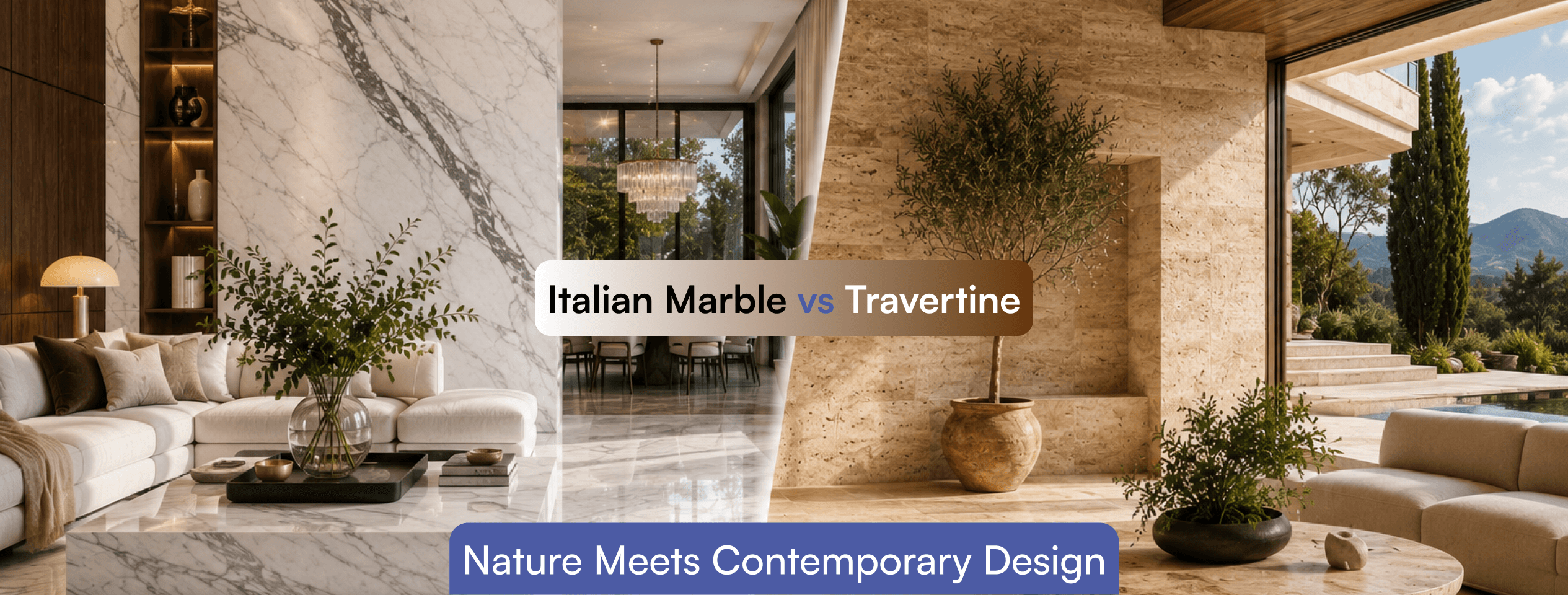
Two villas on the same street, built by the same contractor, in the same year. One owner specified Italian Carrara marble for the living room and staircase. The other chose travertine for the courtyard, the pool deck, and the entrance cladding. Five years on, both surfaces still look deliberate, but they are aging along completely different paths, because the two stones were never really competing for the same job in the first place. Most comparisons of these two materials stop at colour and price. That misses the part that actually determines whether a homeowner is happy with the floor a decade from now: how each stone was formed, how it absorbs moisture, how it wears underfoot, and where in a villa it genuinely belongs. This guide works through that in the sequence a design team would, moving from geology to performance to the room-by-room decisions that shape a project brief. Italian marble begins as limestone that gets trapped deep under mountain ranges, where heat and pressure recrystallize its calcite structure over millions of years. The result is a dense, tightly interlocked crystal matrix, which is exactly why marble takes a mirror polish that porous stones cannot match. Carrara, extracted from the Apuan Alps in Tuscany, remains the reference point for this category, alongside Calacatta and Statuario, which carry bolder, more dramatic veining and command a steeper price for the same reason. The veining itself is not decoration. It marks mineral impurities, mostly iron oxides and clay, that were folded into the stone during metamorphism. A slab cut close to the vein line will read very differently from one cut further away, which is why two marble floors from the same quarry can look like entirely different materials once installed. This is also the detail that separates a competent stone contractor from a design studio: sequencing slabs so veining flows across a floor or a feature wall rather than fighting itself at every joint. Laboratory testing under ASTM C97 sets the maximum allowable water absorption for dense marble at 0.20 percent. Independent test reports on quarried Carrara white marble blocks have recorded absorption figures as low as 0.05 percent, which explains why well-sealed marble performs reliably even in Indian bathrooms and kitchens despite its reputation as a stone that needs careful handling. Travertine forms in an entirely different setting. It is a sedimentary limestone, precipitated rapidly as carbon dioxide escapes from mineral-rich spring water, most famously around Tivoli near Rome. That rapid deposition traps gas bubbles inside the stone as it hardens, leaving the small pits and channels that give travertine its distinctive texture. In raw block form these voids run through the entire stone; in finished slabs, they are usually filled with resin or cement-based grout, or left open for a rustic, tumbled look. Classic ivory travertine is the most familiar variant, but Noce (walnut-toned), Silver, and Gold travertine each come from different mineral concentrations in the source water and carry noticeably different undertones once honed. Where marble reads as formal and reflective, travertine reads as warm and matte, which is precisely why architects reach for it on exteriors that need to soften glare rather than bounce light around a room. The structural trade-off for that texture is porosity. Industry test data places open porosity in natural, unfilled travertine at roughly 10 to 15 percent, against marble's sub-1-percent range in premium grades. Compressive strength for travertine typically falls between 30 and 100 MPa depending on the quarry facies, according to natural stone testing referenced by the Natural Stone Institute's own physical property data sheets. That is a workable range for flooring and cladding, but it means travertine depends far more heavily on correct filling and sealing than marble does. A specification sheet rarely tells the full story on its own, but placed next to each other, these figures explain most of the practical differences a homeowner will notice within the first two monsoons. Sources: ASTM International, C97 Standard Test Methods for Absorption and Bulk Specific Gravity of Dimension Stone and Natural Stone Institute, Travertine Physical Properties Reference. Marble's visual identity comes from contrast: pale background, dark or gold veining, a surface that throws light back into the room. That makes it the natural choice for a double-height foyer, a formal staircase, or a feature wall behind a home bar, anywhere the brief calls for a single element that anchors the entire space. In our own project reviews, marble features work best when the layout gives them room to breathe, a large uninterrupted wall or an open floor plate, rather than being broken up by furniture or partitions. Travertine reads as a continuous texture rather than a focal point. Its linear banding and consistent tone make it better suited to covering large areas without visually overwhelming a space, which is exactly the job it does on a pool deck, a courtyard, or a long verandah. Homeowners who want the material palette of the interior to continue outdoors, without the upkeep marble would demand in direct weather exposure, generally land on travertine for that transition. Material selection for a villa in Tamil Nadu has to account for humidity, monsoon runoff, and long stretches of direct sun on exterior surfaces, conditions that behave very differently from the showroom lighting most buyers see stone samples under. Travertine's textured, honed, or tumbled finish gives it a natural slip resistance that polished marble cannot offer, which is exactly why it performs better on pool decks, open verandahs, and garden pathways where water pools during the monsoon. Marble, by contrast, does best in climate-controlled interiors, air-conditioned living rooms, bedrooms, and formal dining areas, where its higher sensitivity to humidity swings and thermal cycling is not a factor. Installing polished marble in an uncovered courtyard in this region is a common specification mistake; the same stone honed and used indoors performs exactly as intended. R Space's home interior design services in Coimbatore factor this kind of climate behaviour into material selection at the design stage, before a slab is ever ordered. Clean only with pH-neutral stone cleaners; acidic substances such as lemon juice, vinegar, or tomato-based spills will etch the polished surface within minutes. Reseal every 12 to 18 months in high-traffic zones, sooner in kitchens and bathrooms where liquid contact is frequent. Use coasters and trivets on marble countertops heat resistance is good, but acidic and oily staining is the more common complaint. Reseal more frequently than marble, typically every 12 months for exterior applications exposed to monsoon rain and UV cycling. Inspect filled pits periodically; grout or resin fill can wear out of pores over years of foot traffic and needs periodic re-filling. Sweep exterior travertine regularly since the textured surface holds grit that can dull a honed finish faster than a smooth one. On both materials, the biggest maintenance failures we see on handover inspections trace back to skipping the initial factory-grade sealing before installation, not to the stone itself. It is a step worth confirming explicitly in any contractor's scope of work. Pricing for both stones depends on more variables than most quotes make visible: import duty and freight for Italian blocks, the yield a quarry gets from a single block once veining and fissures are accounted for, slab versus tile format, and the complexity of the finish. As a general pattern, premium Italian marble commands a higher price per square foot than travertine, largely because dramatic veining reduces usable yield from each block and because true Italian-quarried material carries import costs that domestically processed travertine does not. Travertine's larger block yield and lower processing complexity typically make it more economical for covering large outdoor areas, which is one practical reason many villa budgets allocate marble to a handful of statement interior zones and travertine to the larger footprint of courtyards, driveways, and decks. This is less a compromise than a deliberate allocation of budget to where each material's strengths actually matter. Formal living rooms and double-height foyers where a single reflective surface sets the tone Staircases and balustrade cladding, where polish and veining continuity read as a design statement Feature walls behind seating or bar units, using bookmatched slabs for a mirrored veining effect Countertops in dry kitchen zones, paired with a honed finish for better everyday resilience Pool decks and courtyards, where its textured finish resists slipping even when wet Exterior facade cladding, where its matte tone weathers UV exposure more gracefully than a high polish Verandahs and garden pathways that need to connect indoor and outdoor material language Bathroom walls and shower surrounds in a honed, filled finish, where its warmth suits a spa-style layout The decision rarely comes down to one stone winning outright. Across the villa projects we have delivered, the pattern that works best treats marble and travertine as complementary rather than competing choices: marble for the two or three spaces that need to make a first impression, travertine for the larger exterior and transitional areas that need durability and slip resistance over years of actual use. The questions worth answering before finalising either material are straightforward. Is the surface exposed to direct weather, or will it stay within a climate-controlled interior? Will the space see bare feet regularly, which pushes the decision toward travertine's textured grip? Does the budget allow for marble's higher price per square foot on the specific area being considered, or does that allocation make more sense elsewhere in the project? A design and execution partner who has handled both materials across enough projects should be able to work through this with you before a single slab is ordered, not after. R Space's turnkey interior design solutions bring exactly this kind of material planning into the execution phase, coordinating stone selection with waterproofing, drainage, and finish schedules so the villa performs as intended long after handover. You can walk through actual marble and travertine applications at our interior design experience center before committing to a material for your own project. Travertine is generally the better choice for outdoor areas. Its honed or tumbled finish provides natural slip resistance, and it tolerates UV exposure and temperature cycling better than polished marble, which is better reserved for climate-controlled interiors. Exterior travertine exposed to monsoon rain and direct sun typically needs resealing annually, while interior travertine can often go longer between applications. The exact interval depends on the finish, the fill quality, and foot traffic. Yes, provided it is properly sealed and finished in honed rather than high-polish for the floor to reduce slip risk. Regular resealing and pH-neutral cleaning are essential since bathrooms see frequent moisture and product contact. In most cases, yes. Travertine generally costs less per square foot than premium Italian marble, largely due to lower import costs and higher usable yield per quarried block, though final pricing depends on grade, finish, and slab size. For open, weather-exposed areas, travertine handles Tamil Nadu's humidity and monsoon conditions more reliably. For interior, air-conditioned living spaces, Italian marble performs well and adds the formal character most villa owners are looking for in these zones. Planning a villa project and weighing stone options for your own home? Get in touch with R Space for a material walkthrough suited to your layout, budget, and climate exposure, or read more design guidance on the R Space blog.What Italian Marble Actually Is
What Travertine Actually Is
Marble vs Travertine: The Numbers Side by Side
Reading the Two Stones in a Finished Space
Performance in Coimbatore's Climate
Maintenance: What Each Stone Actually Demands
Italian Marble
Travertine
Cost Considerations for a Villa Budget
Where Each Stone Belongs in a Villa
Choose Italian Marble For
Choose Travertine For
Making the Call: A Consultant's Framework
Frequently Asked Questions
Is Italian marble or travertine better for outdoor use in a villa?
Does travertine need to be sealed every year?
Can Italian marble be used safely in bathrooms?
Is travertine cheaper than Italian marble?
Which marble suits Tamil Nadu's climate better for villa flooring?