
Mr. K.C. Kailasam - 31 Jul 2026
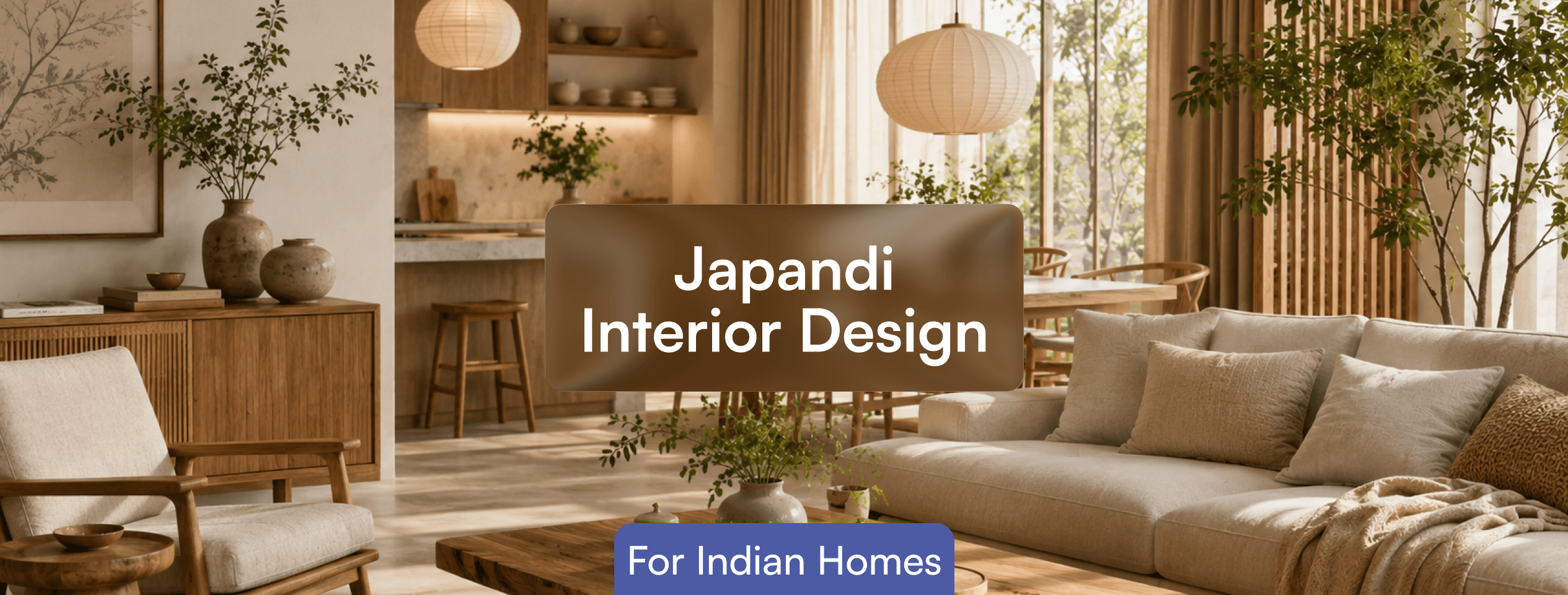
Walk into any interior design showroom in Coimbatore, Bengaluru or Pune you will hear the word Japandi more often than any other style name. Clients bring reference, point at a pale oak console with a single ceramic bowl on it, and ask for that calm Japanese Scandinavian look. What most of them do not realise is that the aesthetic in the photograph was built for a Copenhagen apartment with underfloor heating and a Tokyo condo with earthquake rated joinery, not for a third floor flat in Chennai that gets 85% humidity every July.
That gap between the reference image and the reality of an Indian home is where most Japandi projects go wrong. This guide is written from the other side of that gap, after specifying wood finishes that survive a monsoon, sourcing local materials that mimic the Japandi palette without the import cost and correcting client briefs that confuse minimal with empty.
Japandi is a compound of Japanese and Scandinavian design philosophy. It is not a single historical movement but a design language that architects and stylists began naming around 2016, when writers noticed how closely Japanese wabi-sabi and Scandinavian hygge overlapped in practice, even though they developed continents apart and centuries apart.
Wabi-sabi, the Japanese half of the equation, values imperfection, natural aging and quiet materials over polish and symmetry. A hand-thrown ceramic bowl with a slightly uneven rim is preferred to a machine perfect one. Hygge and lagom, the Danish and Swedish contributions, prioritise comfort, warmth and just enough, rejecting both excess and austerity. When these two philosophies meet in a room, the result is a space that is stripped of clutter but never feels cold, and pared back but never feels bare.
The purpose of Japandi is functional restraint. Every object earns its place by use or by meaning, not by decoration. Its dependency is discipline in procurement, because a Japandi room collapses the moment one mismatched accent piece enters it. Its advantage is longevity, since the palette does not chase trend cycles the way maximalist or heavily themed interiors do. Its limitation is that it demands more from the execution team than from the design brief, because flawless craftsmanship is what makes simple look intentional rather than unfinished.
India's interior design industry was valued at roughly USD 31 to 36 billion in 2025 and is projected to grow at a compound annual rate of 12 to 13% over the next five years, according to Mordor Intelligence's industry analysis. Residential interiors, in particular, are outpacing commercial growth for the first time in years, driven by nuclear families, remote work and a generation of homeowners who have travelled enough to develop opinions about restraint.
Three local shifts explain why Japandi specifically, rather than any other minimal style, is resonating here. First, apartment sizes are still modest by global standards. Average flat sizes across India's top seven cities rose to around 1,676 square feet in 2025, but that number is pulled up sharply by NCR and Hyderabad, according to ANAROCK research reported by Business Standard. In the Mumbai Metropolitan Region, the average apartment remains close to 900 square feet, and many mid-market 2BHK homes across metros fall between 700 and 1,100 square feet. Japandi's low visual clutter and multi-purpose furniture make compact homes feel larger without a renovation.
Second, Indian homes already have a cultural instinct for natural materials and handcrafted objects, from teak furniture passed down through generations to hand-woven textiles. Japandi does not ask Indian homeowners to abandon this instinct. It asks them to edit it, keeping the one heirloom piece that matters and removing the six decorative items competing with it.
Third, joint family living and multi-generational homes create a genuine need for calm, low-stimulation spaces. A home that houses three generations under one roof benefits from rooms that do not visually compete with each other, and Japandi's restrained palette reduces the sensory load of a busy household.
A Japandi interior rests on four pillars, and each has a direct, practical translation for an Indian project.
Neutral, earth-led colour: Think soft beige, warm white, clay, charcoal and muted sage, applied in layers rather than blocks. In an Indian home, this palette also happens to reflect heat better than the darker, saturated tones common in traditional interiors, which is a genuine functional advantage in non air conditioned rooms.
Natural, visible materials: Solid wood, cane, linen, stone and unglazed ceramic replace laminate, glossy PU finishes and printed wallpaper. The material itself is the decoration, so grain, weave and texture carry the visual interest that colour and pattern would otherwise provide.
Low, grounded furniture: Japandi furniture sits closer to the floor than typical Indian showroom pieces, with clean legs, minimal ornamentation and visible joinery. A low slung teak bed frame or a floor hugging sofa reads as Japandi, a high back tufted sofa does not regardless of colour.
Negative space as a design element: Empty wall and floor area is treated as intentional, not unfinished. This is usually the hardest principle for Indian clients to accept, since most briefs start with "what do we fill this wall" rather than does this wall need anything at all.
These four pillars connect directly to how a room is planned. Colour dictates material selection, material selection dictates furniture silhouette, and furniture silhouette dictates how much negative space the layout can actually sustain. Get one wrong and the other three struggle to compensate.
This is the section most Japandi guides skip, and it is the one that determines whether the finished room survives its first monsoon. Pale, raw looking wood finishes photographed in Scandinavian interiors are usually ash, birch or light oak, none of which handle Indian humidity well without heavy treatment. Indoor relative humidity in most Indian cities swings between 55% and 85% during the monsoon months, well above the 40 to 55% range at which solid wood stays dimensionally stable. Untreated pale woods swell, warp at the joints and lose their finish within two to three seasons in coastal or high rainfall regions.
The practical substitution is to keep the Japandi silhouette and colour language while sourcing climate-appropriate species. Teak, with its naturally high oil content, and sheesham, with its dense grain, both take a light, matte, wabi sabi appropriate finish and hold up to humidity swings far better than imported pale woods. Kiln dried mango wood is a third option that has become popular for Japandi style furniture in India precisely because it can be finished pale without the moisture vulnerability of ash or birch.
Linen and cotton blends replace the wool textiles common in Scandinavian Japandi references, since wool performs poorly in humid Indian summers. Locally woven cane and rattan, already familiar to Indian homes through generations of furniture making, slot into Japandi seating and lighting almost without modification, since the material itself sits at the intersection of Japanese and Indian craft traditions.
This is also where an experienced design and build team earns its value. Getting the Japandi look right in an Indian climate is less about copying a reference image and more about knowing which regional material substitutes hold the same visual language without the maintenance risk. R Space's home interior design projects in Coimbatore and Erode are built around exactly this kind of material logic, selecting finishes for the local climate first and the aesthetic second. For homeowners looking for custom interior designers in Coimbatore, this approach is particularly useful when Japandi elements need to be adapted to the home's layout, climate and everyday usage rather than copied from a reference image.
Living room: Anchor the room with one low, solid wood console instead of a wall unit that runs floor to ceiling. Use a single large rug in a soft beige or clay tone to ground the seating instead of patterned Indian dhurries, and keep artwork to one or two pieces rather than a gallery wall.
Kitchen: Open shelving with a handful of unglazed ceramic pieces communicates Japandi far more effectively than closed cabinetry ever will, but Indian kitchens generate more oil and spice residue than Scandinavian or Japanese kitchens. The workable compromise is closed storage for daily cooking equipment and a small open display zone reserved for serveware, keeping the practical mess out of the Japandi sightline entirely.
Bedroom: This is usually the easiest room to convert, since a low platform bed, linen bedding in a muted tone and a single pendant light already deliver most of the Japandi effect without structural change.
Pooja or prayer space: This is the genuinely India-specific adaptation that most Japandi for Western markets, never addresses. A traditional ornate mandir cabinet clashes visually with a Japandi room. The alternative that has worked well on projects is a recessed niche or a low, unadorned wood platform finished in the same material as the rest of the room, treating the sacred space with the same material honesty as everything around it rather than isolating it as a decorative object.
Clients often ask how Japandi differs from the contemporary minimalist and Scandinavian styles already common in Indian interior catalogues. The distinction matters because the three get specified interchangeably, and the wrong one produces a room that looks unfinished rather than intentional.
Pure Scandinavian design leans lighter and brighter, often introducing pastel accent colours and playful forms that Japandi deliberately avoids. Contemporary Indian minimalism, as it is usually executed by builders, tends to strip a room down to white walls and glossy modular units without replacing the removed detail with anything, which reads as empty rather than calm. Japandi sits between the two, retaining warmth and texture through natural materials while still being disciplined about clutter. For a broader comparison of how these and other styles suit different Indian homes, R Space's guide to interior design styles for luxury homes covers the wider landscape in more depth.
The most frequent error is treating Japandi as a shopping list rather than a discipline. Buying a rattan lamp, a beige sofa and a wooden tray does not produce a Japandi room if the wall colour, the flooring and the existing furniture were never edited to match.
The second common mistake is over lighting the space. Japandi interiors rely on layered, warm temperature lighting, typically 2700K to 3000K, rather than the bright cool white lighting still standard in many Indian homes. A single ceiling light at 6000K will flatten every material choice made in the room, regardless of how correct the furniture and palette are.
The third mistake is skipping storage planning. Because Japandi rooms show so little, they demand more concealed storage than a maximalist room, not less. Every item that is not part of the curated display needs a home behind a closed door, which means the joinery plan has to be resolved before the styling begins, not after.
Japandi is often assumed to be expensive because of its association with imported Scandinavian furniture, but the local-material substitutions described earlier bring the cost closer to a well-executed contemporary interior than to a designer import project.
The primary cost driver is not the style itself but the quality of joinery and finish, since Japandi's minimal detailing leaves nowhere for a rushed execution to hide. A poorly mitred wood edge or an uneven matte finish is far more visible in a Japandi room than in a busier, pattern heavy interior. Budgeting should weigh execution quality over furniture volume, since a Japandi brief typically specifies fewer, better made pieces rather than a full room of purchases.
Every Japandi project at R Space starts with a material audit of the site rather than a mood board, checking ventilation, sunlight exposure and existing humidity conditions before recommending wood species or textile choices. This is the same design-and-execution model R Space applies across its turnkey interior solutions, where the same team that designs the space also manufactures and installs it, closing the gap between a Japandi reference image and a Japandi room that still looks right three monsoons later. Homeowners planning a Japandi home in Coimbatore or Erode can see finished material samples and lighting mockups at R Space's experience center before committing to a palette, which resolves most of the material-substitution questions this guide raises before a single order is placed.
Yes, and it is arguably better suited to compact Indian apartments than to large homes. The low furniture profile, multi-purpose pieces and restrained palette reduce visual clutter, which makes a 700 to 1,000 square foot apartment feel more spacious without any structural change.
Scandinavian design favours brighter whites and occasional pastel or playful accents, while Japandi pulls the palette toward warmer, earthier neutrals and prioritises natural material texture over colour or pattern as the main visual interest.
Teak and sheesham are the most reliable choices because their natural oil content and dense grain resist warping and swelling far better than the pale ash or birch typically seen in Scandinavian Japandi references. Kiln-dried mango wood is a practical lighter-toned alternative.
Yes, through adaptation rather than omission. A recessed niche or a low, unadorned wood platform finished in the room's material palette keeps the sacred space visually consistent with a Japandi interior, instead of introducing an ornate cabinet that breaks the room's restraint.
Not inherently. Cost is driven by joinery and finish quality rather than the style itself, since local wood species and textiles replace the imported materials often associated with Scandinavian design. A Japandi brief typically costs less in furniture volume but requires a higher standard of execution.