
Mr. K.C. Kailasam - 05 Aug 2026
Neo-classical interior design is what most people picture when they imagine a luxury traditional home before they can name why. Symmetrical rooms, fluted columns, restrained moulding, a palette that stays quiet instead of shouting. It is one of the few styles that has stayed in continuous demand for over two centuries because it is built on proportion rather than trend, which means it rarely dates the way heavily decorated interiors do.
This guide covers where the style actually comes from, the architectural and material elements that define it, how it differs from styles it gets confused with, and how to apply it in a contemporary Indian home without turning a living room into a museum set. It draws on the same principles our design team applies when clients ask for a traditional, formal aesthetic that still functions as a home someone lives in every day.
Neo-classicism began in the mid-18th century as a direct reaction against the ornate curves and excess of Rococo design. According to the Metropolitan Museum of Art, the style grew out of first-hand study and reproduction of antique Greek and Roman works, gaining momentum as archaeological excavations at Pompeii and Herculaneum put classical proportion and ornament back in front of European designers and architects. What started as an art historical movement became a full design language covering architecture, furniture, painting and interiors within a few decades.
This origin matters because it explains why neo-classical interiors behave the way they do. The style was never meant to be decorative for its own sake. Every column, pediment and cornice traces back to structural elements from Greek and Roman temples, which is why the style reads as ordered rather than busy, even when a room contains a good amount of detail.
The Enlightenment context is worth knowing too. Neo classicism rose alongside a broader cultural shift toward reason, science and intellectual restraint, and interiors of the period were meant to reflect that same clarity of thought. A neo-classical room was, in effect, a physical argument for order over impulse. That is still the underlying logic a designer is working with today, even in a home with no interest in 18th century philosophy.
Clients often use neo-classical, classical and traditional interchangeably, but they describe different things. Classical design refers to the original Greek and Roman architecture itself, the temples, the orders of columns, the source material. Neo-classical is the 18th and 19th century revival of that source material, filtered through European architects who were reinterpreting classic heritage for their own era rather than copying it directly.
Traditional design is a broader, looser umbrella that can include neo-classical influences alongside Victorian, colonial or regional decorative styles. A traditional living room might borrow a neo-classical cornice profile without adopting the symmetry or restraint that defines the style at its core. For homeowners looking for this more enduring design language, classic interior designers in coimbatore can help adapt traditional detailing to the proportions, materials and practical requirements of a contemporary home. Understanding this distinction matters when you are briefing a designer or architect, because asking for traditional and asking for neo-classical will produce genuinely different floor plans, not just different furniture.
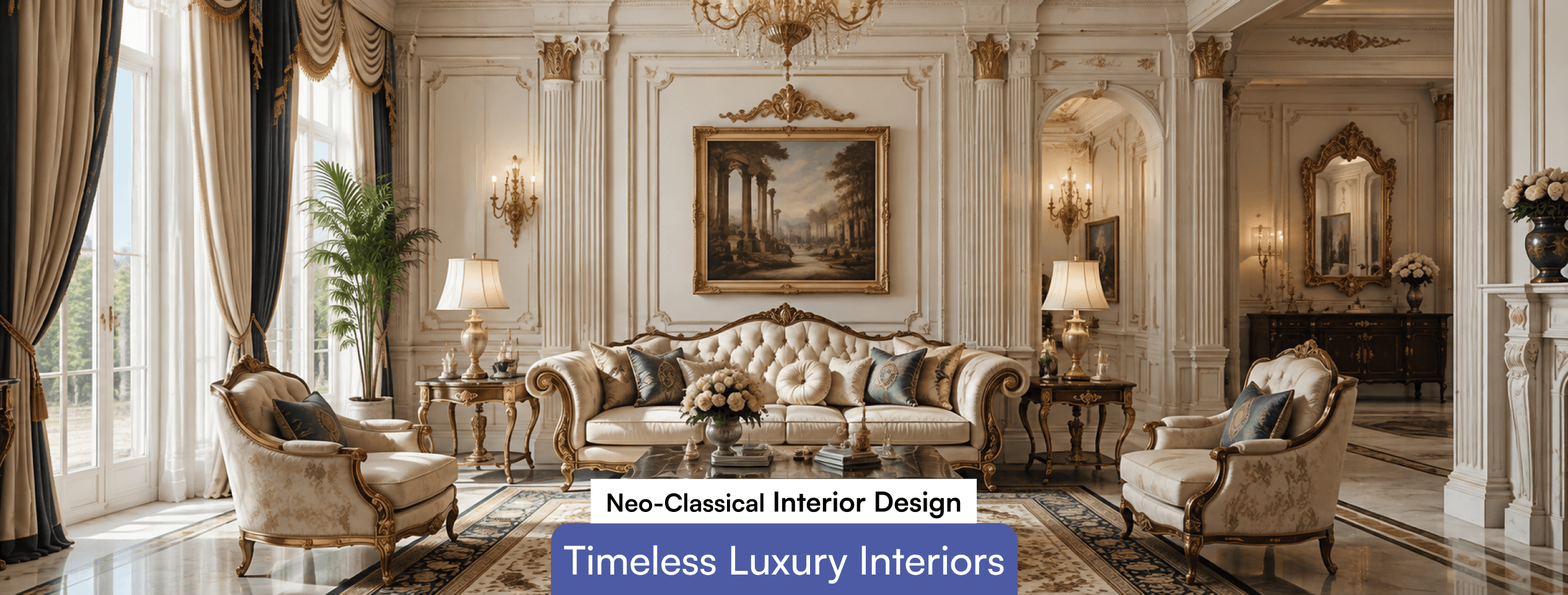
Every neo-classical room is organised around a central axis, with elements mirrored on either side of it. A fireplace or a console table typically anchors the axis, with matching lamps, artwork or seating balanced left and right. This is not a minor styling detail. It is the single most identifying feature of the style, and a room with strong classical furniture but no symmetry will not read as neo-classical no matter how correct the individual pieces are.
Columns and pilasters, which are flattened columns attached to a wall, are used both structurally and decoratively. Their proportions follow the classical orders, Doric, Ionic and classical architectural style , each with a different level of interior detailing on the capital. Doric is plainest and most solid in appearance, Ionic introduces the scrolled volute, and classical style carries the most decorative acanthus leaf carving. Choosing the wrong order for a room's scale is a common mistake; an overly ornate classical style capital in a modest room can look imported rather than integrated.
Mouldings define the transitions between wall, ceiling and floor, and in neo-classical interiors they are precise rather than heavy. Cornices run along the top of a wall where it meets the ceiling, friezes provide a decorative horizontal band often below the cornice, and ceiling roses mark the centre point of a room, usually above a chandelier. These elements exist to add depth and rhythm to a plain wall without requiring colour or pattern, which is part of why the style photographs so well in a restrained palette.
Decorative architectural features, the triangular or curved elements often placed above doorways and windows, borrow directly from temple architecture and signal formality at entry points. Arches appear in doorways and passageways to create a sense of procession through a home, guiding movement from one room to the next in a way that a plain rectangular opening does not.
Neo-classical interiors rely on a muted palette: soft whites, ivory, pale grey, dusty blue and occasional muted gold accents. The restraint in colour is deliberate. It lets the architectural detailing, the mouldings, the cornice work, the column proportions, carry the visual weight of the room instead of competing with strong colour blocks.
Materials lean toward marble, fine hardwoods, gilt bronze and high quality textiles like silk and damask for drapery. Marble in particular has a long-standing relationship with this style, both as flooring and as a material for mantels, tabletops and plinths used to display sculpture or decorative vases. Its natural veining and cool polish echo the same historic classical architecture the entire style is built around.
Furniture follows the same logic as the architecture: clean lines, fluted legs, symmetrical proportions, and carved details kept restrained rather than excessive. Chairs and sofas often have straight, tapered legs rather than the curved cabriole legs associated with Rococo or Baroque furniture, and case pieces like commodes and cabinets tend toward geometric rather than ornate silhouettes.
Full neo classical interiors, the kind found in European palaces, are rarely practical or desirable in a contemporary home. What works better, and what we recommend to most clients, is a contemporary neo-classical approach that borrows the bones of the style without recreating a period room.
Keep symmetry in the layout, even if the furniture itself is simpler and more contemporary in silhouette
Use one or two architectural moments, a cornice detail, an arched doorway, rather than layering every classical element into a single room
Choose a slim-profile column or pilaster where structurally appropriate instead of a heavy, full-order column that can overwhelm a smaller room
Let marble or a marble-look material carry the classical reference in flooring or a feature wall rather than relying on ornate furniture alone
Reserve gilded accents for a few pieces, a mirror frame or picture frames, instead of gold trim throughout
This restrained approach sits closer to what we cover in our broader guide to interior design styles for luxury homes, where neo-classical is one of several traditional leaning styles we compare against more contemporary options for South Indian homes.
Entry points and formal living rooms are where neo-classical detailing earns its cost fastest. A symmetrical foyer with a pediment over the main doorway, paired console tables and a centred light fixture sets the tone for the whole home before a visitor sees another room.
Dining rooms take naturally to the style because the furniture arrangement is already symmetrical by function, a table centred under a chandelier with chairs balanced on either side. Wall panelling with fluted pilasters on either side of a sideboard reinforces the axis without needing much additional decoration.
A staircase with a classical baluster profile and a restrained runner is one of the more cost efficient ways to introduce the style, since the architectural impact is high relative to the material used. It is also one of the first things a visitor notices on entry, which makes it worth getting right early in a renovation rather than treating it as an afterthought.
The most frequent error is treating the style as maximalist rather than restrained. Neo-classical design is defined by what it leaves out as much as what it includes, and a room with columns, heavy mouldings, gilded furniture and patterned upholstery all at once reads as costume rather than architecture.
The second common mistake is ignoring scale. A pediment or column sized for a grand European hall will look disproportionate in a standard residential ceiling height, and a good architect will adjust the proportions of every classical element to the actual room rather than copying a reference image at face value.
The third is skipping the planning stage entirely and adding classical details after a layout is finalised. Because the entire style depends on a central axis and symmetry, it needs to be considered at the floor plan stage, not bolted onto a room after furniture placement is already decided.
Neo-classical interiors reward planning more than almost any other style, because symmetry and proportion have to be built into the layout from the start rather than corrected later with furniture and accessories. If you are considering this direction for a home, our home interior design team in Coimbatore can help translate the style into a floor plan that still works for daily living, and you can see the reasoning behind our material choices for statement spaces on our website.
Classical design refers to the original Greek and Roman architecture itself. Neo-classical is the 18th and 19th century revival of those classical principles, reinterpreted by European designers rather than copied directly from ancient buildings.
Yes, particularly in a contemporary, simplified form that keeps the symmetry and proportion of the original style while reducing ornamentation. It remains a common request for formal living rooms, foyers and traditional luxury homes.
Muted, restrained tones work best: soft white, ivory, pale grey and dusty blue, occasionally paired with gold or bronze accents. Strong or saturated colour tends to compete with the architectural detailing rather than support it.
Yes, provided the scale of columns, mouldings and furniture is adjusted down to match the room. A single well-proportioned architectural moment, like an arched doorway or a detailed cornice, is more effective in a smaller space than trying to fit in every classical element at once.
Marble, fine hardwoods, and quality textiles like silk or damask are the core materials, often finished in light, polished tones. Gilt bronze or gold-toned metal accents are used selectively rather than throughout the space.