
Mr. K.C. Kailasam - 02 Aug 2026
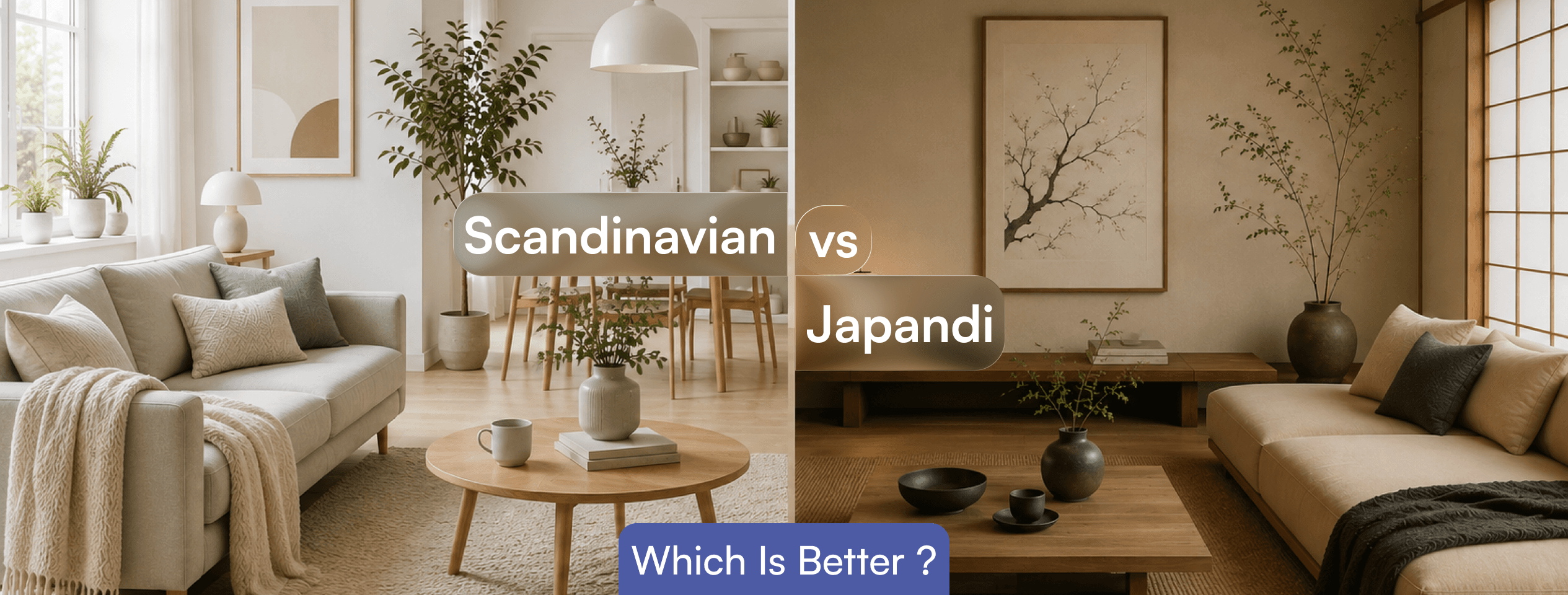
Most homeowners come to us with a Pinterest board, not a plan. Half the saved images are airy white rooms with pale wood floors. The other half are dim, moody spaces with low furniture and a single ceramic bowl on a shelf. Both get called “minimalist,” and the client assumes they are the same style with different paint colours. They are not.
The first is Scandinavian design, built for countries with six months of low daylight. The second is Japandi, a newer hybrid of Japanese wabi-sabi and Nordic hygge that behaves very differently once it meets Coimbatore’s humidity, strong daylight, and available timber. Choosing between them affects your material budget, your maintenance routine, and how the space will actually look three monsoons from now, not just on handover day.
Scandinavian design emerged out of Nordic functionalism in the 1950s, when architects in Sweden, Denmark, and Norway began designing furniture and interiors around two constraints: limited daylight for most of the year, and a cultural preference for democratic, mass-producible design over ornamentation. The result is a style built to maximise the light a room does get.
Its defining features are a white or pale-grey base, light-toned wood such as ash, birch, or pale oak, functional furniture with visible legs rather than boxy bases, and a controlled use of colour, usually one or two muted accents against the neutral base. The Danish idea of hygge, cosiness through soft textiles and warm lighting, was layered onto the style later, softening what could otherwise read as clinical.
In a South Indian home, Scandinavian design solves a problem you don’t have. Coimbatore isn’t short on daylight. What it does deliver is a bright, low-maintenance-looking finish that photographs well and suits homeowners who want a clean, resale-friendly interior without heavy customisation.
For a broader look at how different aesthetics translate to this region, see our complete guide to interior design styles for luxury homes in South India.
Japandi is the term the design press settled on around 2017 for interiors that combine Japanese wabi-sabi, finding beauty in imperfection and restraint, with Scandinavian hygge. It gained real momentum through 2020 and 2021, when homeowners spending more time indoors started prioritising rooms that felt calm rather than merely photogenic, and it has continued to grow since; Pinterest recorded a 100 percent year-on-year jump in searches for the style in its 2021 Pinterest Predicts trends report.
Where Scandinavian design brightens a room, Japandi restrains it. Furniture sits low, often under 40 centimetres in height. Wood tones run darker: walnut, smoked oak, or in an Indian context, teak and sheesham. Decor is sparse by design, not by neglect, a single well-made object on a shelf rather than an empty shelf. The Japanese concept of ma, deliberate negative space, is treated as a design element in its own right, not unused square footage.
This restraint has a practical side effect that matters more in India than the aesthetic does. Teak and sheesham are naturally resistant to humidity and termites, so a Japandi material palette often needs less chemical treatment and fewer sealant top-ups than pale imported-look wood.
Whichever style you choose, ask your designer whether the new timber carries Forest Stewardship Council (FSC) certification, the standard that verifies wood comes from responsibly managed forests rather than unregulated logging.
Climate is the deciding factor most mood boards never account for. Coimbatore runs warm and humid for most of the year, with a strong monsoon season. Pale Scandinavian wood tones, ash and birch in particular, aren’t native species here; achieving the look usually means light-toned veneers or engineered wood that need a moisture-resistant seal and, ideally, rooms that stay climate-controlled. Skip that step and the finish yellows or stains within a couple of years.
Japandi’s darker, denser woods handle the same conditions with far less intervention. Teak has been the default material for humid-climate furniture in South India for generations for exactly this reason. The style’s muted, earthy palette also does a quieter job than stark white walls at hiding the dust and glare that come with Coimbatore’s bright daylight, so the room needs less frequent repainting to stay looking fresh.
None of this makes Scandinavian design a poor choice. It remains the more resale-neutral option and reads brighter in rooms with limited window area. The honest advice we give clients is that Scandinavian suits homes prioritising a light, open, easy-resale finish, while Japandi suits homes prioritising low upkeep and a warmer, lived-in feel that ages well through Coimbatore’s weather.
Living room: Scandinavian pairs a light wood console with wool or cotton throws and one muted accent colour. Japandi pairs a low sofa with a linen slipcover, a single low console, and a floor-level accent light rather than an overhead fixture.
Bedroom: Scandinavian uses a standard-height bed frame in pale wood with white or pastel linen. Japandi uses a low platform bed, often under 40 cm, in teak or sheesham with earth-toned bedding.
Kitchen: Scandinavian favours white or pastel cabinetry with visible hardware and open shelving. Japandi favours handleless matte cabinetry in warm neutral tones with a stone or clay-look countertop and minimal open display.
Material cost alone rarely decides the budget gap; labour does. A standard-height Scandinavian wardrobe or bed uses conventional modular joinery that most factory lines already produce efficiently. Low-profile Japandi furniture requires custom leg heights, exposed joints, and tighter finishing tolerances, which adds carpenter hours even when the raw material, teak or sheesham, costs about the same as an imported-look veneer.
There’s also a sourcing trend worth factoring in. In 1stDibs’ 2026 designer trends survey, 85 percent of surveyed designers reported sourcing vintage furniture for client projects, and 63 percent used pre-1920s antiques, both the highest proportions recorded in the survey’s history. For homeowners, this signals that mixing one or two vintage or reclaimed pieces into a Japandi room isn’t a compromise on the style, it’s consistent with where the wider design industry is already heading, and it can offset new-furniture cost without diluting the aesthetic.
Treating minimalism as emptiness. Japandi is curated fullness, not a bare room; a Scandinavian room without any texture layer reads cold rather than calm.
Skipping the moisture seal on pale wood. This is the single most common reason Scandinavian interiors in humid Indian cities look tired within two years.
Under-planning storage. Both styles depend on hidden storage to keep surfaces clear; without it, homeowners revert to visible clutter within months of handover.
Overlighting a Japandi room. Bright, uniform overhead lighting fights the style’s intent; layered, low-level lighting is part of the design, not an afterthought.
For homeowners who want a refined, clutter-free space without losing warmth or functionality, working with minimalist interior designers in Coimbatore can help translate these principles into a practical home.
Four questions settle most decisions in our client consultations: How much natural daylight does the room already get? Rooms with strong daylight suit Japandi’s deeper tones; darker rooms benefit from Scandinavian brightening. What’s the household’s tolerance for maintenance? Japandi’s natural wood forgives humidity better than pale finishes. Who uses the space, children and pets included? Darker, matte Japandi surfaces hide daily wear better than white Scandinavian ones. And finally, is resale value or personal comfort the priority? Scandinavian tends to read as more universally market-ready; Japandi tends to feel more personally restorative to live in day to day.
Our home interior design services in Coimbatore have executed both Scandinavian and Japandi interiors across residential projects, and because our design team runs manufacturing in-house rather than outsourcing across multiple vendors, decisions like wood species, sealing method, and joinery tolerance are controlled from concept through final handover, not left to whichever workshop happens to be available.
If you’re still weighing the two styles against your own home’s layout and daylight, our team can walk through both options in person; you can book a free design consultation or visit our experience centre to see finished material samples of each before committing.
Not inherently. Scandinavian interiors often lean on imported-look pale wood veneers, which push up material cost, while Japandi favors teak and sheesham that are readily available in South India. What raises the Japandi budget is joinery: low-profile furniture with exposed, precise joints takes more carpenter hours than standard-height modular units.
Yes, with adjustments. Pale ash and birch tones need proper sealing and, ideally, climate-controlled rooms to resist the humidity swings of a Tamil Nadu monsoon. We typically substitute true Scandinavian species with light-toned local ply and veneer that are engineered for humidity, so the look survives without the maintenance headache.
Scandinavian design brightens a space to compensate for long, dark Nordic winters; Japandi restrains a space so that daylight, material, and empty space carry equal weight.
Japandi generally reads larger in compact Indian apartments because low furniture keeps sightlines open and darker tones anchor a room without needing the wall-to-wall white that Scandinavian design relies on for a sense of scale.
No. Many 2026 Japandi interiors mix a dominant warm neutral base with one darker anchor material, such as a walnut console or a charcoal accent wall, rather than using dark wood throughout.
Seal all light wood surfaces with a moisture-resistant finish, keep white upholstery to washable or slip-covered fabric, and budget for touch-up painting on walls every few years, since pale walls show humidity staining faster than warmer tones.
Yes. Many of our Coimbatore clients ask for a Scandi-Japandi hybrid: a light, airy living room in the Scandinavian mode that transitions into a low-furniture, warm-toned Japandi bedroom. The two philosophies share enough DNA, functionality and restraint, to blend without feeling disjointed.
Scandinavian interiors favour light engineered wood or pale matte vitrified tile. Japandi interiors favour warm-toned wood-look tile, natural stone, or matte finishes that avoid a reflective, showroom sheen.
For a typical 2 or 3BHK in Coimbatore, design finalisation runs 2 to 3 weeks and execution 60 to 90 days, depending on how much bespoke joinery the Japandi furniture requires.
Yes. Our in-house design and manufacturing team executes both Scandinavian and Japandi interiors, which means the wood selection, sealing, and joinery decisions are controlled end-to-end rather than outsourced piecemeal.