
Mr. K.C. Kailasam - 27 Oct 2026
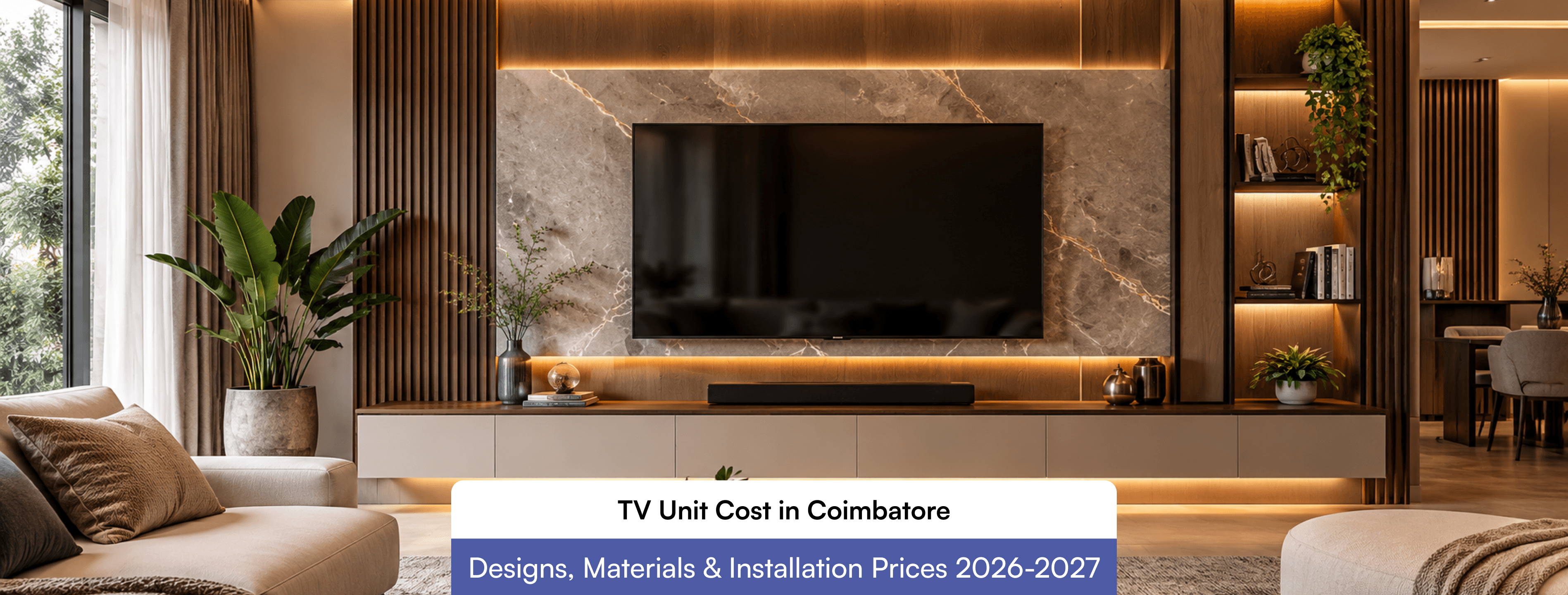
A TV unit in Coimbatore typically costs ₹600 to ₹2,000 per sq ft of front elevation when built in engineered wood or plywood, which puts a standard 8 ft by 7 ft wall unit between roughly ₹34,000 and ₹1.1 lakh. Solid wood units begin around ₹2,500 per sq ft, and they shift with plywood grade, finish and the amount of storage you add. The number on a quote matters less than what sits behind it. Data for India’s analysis of household assets puts television ownership in Tamil Nadu at 87 percent of households, so nearly every living room here needs a TV wall, yet two quotes for the same wall can differ by half because the scope is different. This guide shows how the price is built so you can compare quotes on equal terms. Coimbatore workshops price TV units per square foot of the finished front elevation, meaning width multiplied by height, including open niches. The table applies each rate band to a common 8 ft by 7 ft wall unit (56 sq ft) so totals are easy to compare. These are indicative market ranges, not an R Space quotation. Published Coimbatore workshop listings show PVC units at roughly ₹250 to ₹450 per sq ft and MDF or plywood units at ₹600 to ₹950, while some material guide lists laminate and engineered wood at ₹600 to ₹2,000 and solid wood at ₹2,500 to ₹5,000. Your final figure depends on a site measurement. A TV unit is a set of connected parts, and each part moves the price differently. The carcass is the plywood or MDF box that carries the load. Shutters and drawers sit on the carcass and carry the visible finish plus hardware such as hinges and channels. The back panel frames the screen, and the electrical layer behind it feeds every device. The per sq ft rate normally covers carcass, shutters and standard hardware. It rarely covers wiring, lighting or wall painting. This is why shutters matter more than size. Two 56 sq ft units can land in very different price bands if one is mostly open niches and the other is mostly closed storage, because closed shutters carry finish and hardware on every panel. The second trap is the measurement basis. Some quotes charge for the entire wall including empty gaps, others for the built area only. Ask which one your quote uses before comparing rates. A floating unit hangs from the wall, which keeps the floor clear and makes cleaning easier. It depends on sound backing: masonry walls need proper fixings, and partition walls need a plywood frame behind the board. That hidden support is why floating units sit in the upper half of the plywood band. Workshop listings for plywood wall-mounted units with drawers, sized for 70 inch screens, start near ₹900 per sq ft. A console sits on the floor and is the cheapest route, often built in PVC, UPVC or MDF. It suits rented homes and compact halls, but it occupies floor space and collects dust underneath. Load capacity is lower in PVC, so check the shelf rating before placing a large screen or soundbar on it. A full-wall unit combines the TV niche with closed storage and display shelves. It works in 2BHK and 3BHK homes where the living room doubles as a family space and the set-top box, game console and decor need somewhere to hide. Cost rises with area, and the large shutter surface pushes it into the mid-range band even in laminate. Here the TV is mounted on a feature wall of fluted panels, louvers or veneer, with a slim ledge below. Panel finish drives the price, and wiring must be concealed behind the panel before it is fixed. It is a common premium choice because it delivers the look with less storage cost. In villas and duplexes, the unit is sometimes built as a partition between the living area and the foyer or staircase, with the TV on one face and a display or pooja niche on the other. It needs a structural frame and finishing on both faces, so it costs more than a wall unit of the same size and should be designed together with the false ceiling and lighting. Material choice sets both durability and price, and plywood labels are often misunderstood. The Bureau of Indian Standards covers general purpose plywood under IS 303, and a recent revision added a boiling water proof (BWP) grade alongside BWR, with each grade further classified by formaldehyde emission class such as E1. Marine plywood sits under a separate standard, IS 710, which requires the glue line to survive a 72 hour boil test. For a living room unit, moisture resistant or BWR plywood with an E1 rating is usually enough. BWP or marine grade adds cost without adding value on a dry wall. Coimbatore is inland and generally less humid than coastal cities such as Chennai, so the real risk to a TV unit is a damp external wall, not the air. If the TV wall shares a side with an exterior wall that shows monsoon seepage, fix the waterproofing first and keep a laminate-backed panel between the carcass and the wall. MDF is smooth and takes paint and PU finishes well, but it swells when edges are left unsealed. Commercial plywood holds screws better and tolerates shelf loads. UPVC resists termites and moisture and suits budget builds, with fewer finish options. Solid wood lasts longest and costs most, so it is usually reserved for frames and accents rather than complete units. On the surface, laminate is the cost-effective default, acrylic gives a high gloss that shows scratches under bright window light, and veneer with a PU finish brings warmth at a higher labour cost. Most TV unit failures we see trace back to unsealed edges and unsupported shelf spans beyond about 900 mm, not to the plywood brand. Most handover disputes come from items that were assumed to be included. Treat each of the following as a separate line until the quote says otherwise. Power planning deserves attention. A typical setup feeds the TV, set-top box, soundbar, game console, router and one spare, so six sockets behind the unit is common. Leave a ventilation gap or a perforated shutter for the equipment, because a fully sealed cabinet traps heat. Size decisions affect cost because every extra foot of width adds elevation area. The Society of Motion Picture and Television Engineers recommends a 30 degree viewing angle, which works out to a seating distance of about 1.63 times the screen diagonal, as explained by Sound & Vision. Applied to common screens, a 43 inch TV suits a seat about 5.8 ft away, a 55 inch about 7.5 ft, a 65 inch about 8.8 ft and a 75 inch about 10.2 ft. If your sofa sits around 8 ft from the wall, a 55 to 65 inch screen fits better than a 75 inch, and the width you save can go toward storage. For the unit itself, plan the TV centre close to seated eye level, commonly 40 to 45 inches from the floor, and leave about 12 to 18 inches of clear width on each side of the screen. Mounting too high is the most frequent correction we make on site. Site visit and wall check: Measure the wall, identify the wall type, check for seepage and note existing electrical points. Design and 3D approval: Confirm the elevation, TV size, storage and finish samples. Electrical rough-in: Conduits and sockets go in before panelling and paint. Workshop fabrication: Carcass and shutters are cut and edge-banded in a workshop, which keeps dust off your site. On-site installation: Units are fixed and aligned, usually within two to four days. Finishing and handover: Lighting, TV mounting, hardware adjustment and a snag check close the job. From design approval, a standalone unit generally takes two to three weeks. Inside a full home project it follows the civil and electrical sequence, so the TV wall is planned early rather than added after painting. Designcafe’s Coimbatore cost guide places whole-home interiors at ₹1,500 to ₹2,500 per sq ft, with a 2BHK of 800 to 1,100 sq ft at roughly ₹6 lakh to ₹10 lakh. Against that benchmark, a mid-range TV unit at ₹50,000 to ₹78,000 is about 5 to 13 percent of the budget, which makes it one of the easier items to upgrade. Spend on hardware, edge banding and wiring, because these decide how the unit ages. Save on back panel finishes and decorative open shelves, which add cost faster than function. If the TV wall is part of a larger living room plan, our home interior design services in Coimbatore show how it ties into the ceiling, lighting and furniture layout. A lower rate with a vague scope usually ends higher after additions. Ask each designer for the same five things: An elevation drawing with dimensions, and whether the rate applies to the full wall or the built area Plywood or MDF brand, grade and BIS mark, plus laminate thickness Hardware brand for hinges, channels and handles Separate lines for electrical, lighting, panelling and bracket Warranty terms and what they exclude R Space is an interior design company in Coimbatore that designs, fabricates and installs TV units as part of living room and full home projects. We start with the wall, the TV size and the seating distance, then price the unit line by line so the quote matches what gets built. Send photos of your wall, your TV size and your sofa position, and we can share a realistic range before the site visit. Most laminate or plywood TV units cost ₹600 to ₹2,000 per sq ft, which is roughly ₹34,000 to ₹1.1 lakh for an 8 ft by 7 ft wall. For living rooms, BWR plywood with an E1 formaldehyde rating and a laminate finish gives the best balance. BWP or marine grade is meant for wet areas such as kitchens, MDF suits painted or PU finishes with sealed edges, and UPVC fits tight budgets. Installation is usually part of a workshop’s rate, but concealed wiring, LED lighting, wall panelling, painting and the TV bracket are normally separate. Confirm each one as its own line in the quote. A standalone unit usually takes two to three weeks from design approval, with on-site fixing taking two to four days. Units inside a full home project follow the electrical and civil schedule.TV Unit Cost in Coimbatore at a Glance
How a TV Unit Quote Is Actually Built
TV Unit Designs and What Each Costs
Wall-mounted floating unit
Floor-standing console
Full-wall unit with storage
Panelled backdrop with a floating ledge
Partition TV unit
Materials and Finishes: What You Pay For
Wiring, Lighting and Other Costs Outside the Rate
Sizing the Unit to the TV and the Room
Installation Process and Timeline
Where the TV Unit Sits in Your Total Interior Budget
How to Compare TV Unit Quotes Properly
Planning a TV Unit with R Space
Frequently Asked Questions
What is the average TV unit cost in Coimbatore?
Which material is best for a TV unit in Coimbatore?
Does the TV unit price include wiring, lighting and installation?
How long does it take to build and install a TV unit?