
Mr. K.C. Kailasam - 23 Oct 2026
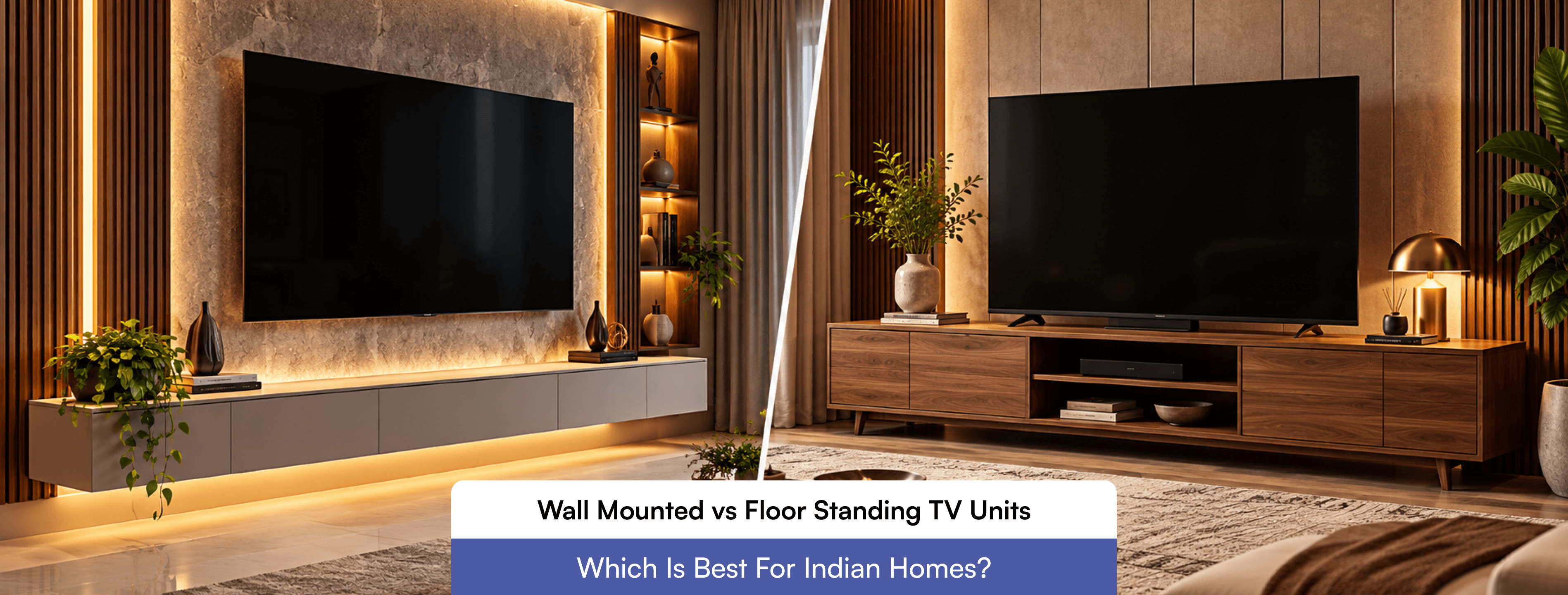
Most homeowners ask this question after the sofa is chosen and the wall is already painted, which is the wrong order. The choice between wall mounted vs floor standing TV units depends less on style and more on three things, what your wall is made of, where the cables run, and who uses the room every day. At R Space, the TV wall is one of the first details we freeze during planning, because it decides the electrical conduit positions, the plaster finish and the carpentry sizes. For most Indian apartments and compact halls, a wall mounted TV unit is the better fit. It keeps the floor clear for daily mopping and makes a small room look larger. A floor standing TV unit is the better fit when you need closed storage, when the wall cannot safely take load, or when you rent and expect to move. In larger halls and independent houses, a hybrid usually works best, the TV on a wall panel or bracket, with a low unit below it for equipment and storage. The terms are used loosely, and this causes confusion at the quotation stage. Three different things are called wall mounted. Bracket mounted TV: only the television hangs on the wall. The furniture below it is separate. Floating cabinet: a storage unit fixed to the wall at height, with visible floor underneath. Full TV wall unit: a back panel with side storage, shelves and lighting, where the TV is either recessed or bracketed. A floor standing unit rests on its own base, plinth or legs and carries its own weight. The TV sits on top of it or on a bracket above it. The simplest way to understand the difference is to follow the load. In a floor standing setup, the floor carries the cabinet and the wall carries nothing, or only the TV. In a floating setup, the wall carries both. That single difference explains most of the gaps in cost, safety and maintenance between the two. A floor standing unit is a self-supporting cabinet, usually 350 to 450 mm deep, built in plywood with laminate or veneer. In humid areas and on ground floors, we prefer boiling waterproof (BWP) plywood for the carcass, because the base of a floor unit is the part most exposed to damp and mop water. Its main advantage is independence from the wall. It works against brick, AAC block, hollow block or a gypsum partition without any structural check, and it can hold heavy items such as a home theatre receiver, a router, a DVR and board games. It can also be moved when you rearrange the room or change homes. The limitations show up in daily use. Dust collects under and behind the unit, and in homes where floors are mopped daily, a unit with a closed plinth is far easier to keep clean than one on thin legs. A low unit also pushes the screen centre down, which we cover in the viewing section. Tall floor units with a TV on top are the most top-heavy combination, which matters in homes with toddlers. A typical case, a family in a three-bedroom apartment needed to hide a set-top box, a gaming console and children's books near the TV. A floor standing unit with closed shutters solved this in one piece of furniture. A floating cabinet would have needed a separate storage unit elsewhere. A floating TV cabinet hangs from a steel cleat or concealed brackets fixed into the wall. Because the floor stays visible, the room reads larger, a robot vacuum or mop passes freely underneath, and LED strip lighting under the unit adds depth. Wiring can run inside the wall and emerge behind the unit, so no cable is visible. The limits are load and permanence. A floating unit can only hold what the wall and its fixings can hold, so heavy storage belongs elsewhere. It cannot be relocated without repairing the wall. And a closed floating box with a set-top box inside has no airflow unless a ventilation gap is designed in. On external walls, seepage is a risk, because moisture behind a panel stays hidden until the laminate lifts. Indian homes use several wall types, and each one holds a fix differently. One more check before drilling. The wall behind a TV is often shared with a bedroom, kitchen or bathroom, and it may hide electrical conduits or water lines. We mark the concealed conduit and pipe layout before any fixing is planned. Cable planning is where wall mounted setups succeed or fail. The conduits for HDMI, power, Ethernet and soundbar cables must be laid before plastering and putty, along with a recess box behind the TV so the plug does not push the screen off the wall. We usually provide four to six sockets in the TV zone for the TV, set-top box, soundbar, router and a spare, and we recommend a surge-protected extension rather than loose plug points, given the voltage fluctuation many homes see. Heat is the second factor. Set-top boxes, consoles and routers run warm, and a closed floating cabinet traps that heat. We leave a ventilation gap at the back or use perforated shutters. Because the civil, electrical and carpentry teams must agree on these positions at the same time, this is one of the reasons we explain how a turnkey model compares with separate contractors to clients planning a full home. Standards bodies give a clear target. SMPTE recommends that the screen fills about 30 degrees of your horizontal view, and THX recommends about 36 to 40 degrees for a more immersive setup, as explained in this size and distance guide. Converted to a real room, a 55 inch TV (about 1.2 m wide) reaches 30 degrees from roughly 2.3 m and 40 degrees from about 1.7 m. A 65 inch TV reaches 30 degrees from about 2.7 m. If your sofa sits 2.5 to 3.5 m from the wall, a 55 to 65 inch screen is the sensible range. Height is where the two unit types differ. The screen centre should sit near seated eye level, typically 1,000 to 1,100 mm from the floor, though your sofa height changes this. A 55 inch TV standing on a 450 mm floor unit has its centre at roughly 850 mm, which is lower than comfortable for most sofas. A bracket or wall panel lets us set the exact height, and a tilt bracket helps if there is a window facing the screen and glare is a problem. The US Consumer Product Safety Commission reported that 47 percent of tip-over fatalities between 2013 and July 2023 involved a television, and that an average of 17,800 people a year were treated in emergency departments for tip-over injuries, according to its Anchor It campaign release. These are American figures, but the physics applies to any home with a narrow cabinet, a heavy TV and a curious toddler. For floor standing units, the practical fix is a sturdy low base, the TV pushed back, and an anti-tip strap anchored into the wall. For wall mounted TVs, the bracket must be rated above the TV weight and match its VESA hole pattern, and the real risk is the fixing, not the bracket. A good bracket on plaster alone will fail. Neither option is safe by default. Both need correct installation. Material and finish affect both options as much as the format does. Laminate edges, shutter hardware and back panels are easier to judge in person, which is why we suggest visiting the R Space experience center before finalising a TV wall. Compact apartment halls: a floating cabinet with a bracket mounted TV keeps the floor open and the room bright. Independent houses and villas: a full TV wall unit with side storage and a low base makes use of the wall width. Rented homes: a floor standing unit avoids wall damage and moves with you. Joint families and storage-heavy homes: floor standing units with closed shutters hold puja items, documents and media equipment. Homes with toddlers: a low anchored floor unit or a high wall mounted TV both work. A TV on a loose narrow stand does not. Placement according to Vastu is a common request in Coimbatore homes. It is a preference rather than an engineering factor, and we accommodate it as long as the wall and wiring allow. Our home interior designer team in Coimbatore reviews the wall, the seating distance and the family routine together before recommending a format. Sealed panels with no service access, so replacing a failed HDMI cable means breaking the panel. A cut-out sized exactly to the current TV. Counterpoint Research found that 43 inch TVs led Indian smart TV shipments in 2025 while 55 inch and larger models drove growth, so many owners upgraded within a few years. We leave margin in the recess. Curtain tracks and pelmets planned without checking the TV wall, which blocks light or crowds the screen. Soundbars and speakers added later with no shelf or clearance, so they sit on the floor or block the screen base. Ordering the unit before deciding the TV size and sofa distance. R Space has designed and manufactured interiors since 1996 as part of Royal Furnitures, and we hold ISO 9001 and 14001 certification. As an interior design company in Coimbatore with in-house manufacturing, we fabricate TV units to site measurements rather than adjusting standard sizes on installation day. Our process starts with the wall, construction type, concealed services, seating distance, window position and TV size. The electrical drawing follows, then the unit design, then factory production. The TV wall is installed only after the conduit, plaster and paint stages are complete, which avoids the rework that comes from fitting a finished panel around late wiring changes. Check the wall type first, then the cable route, then the seating distance and who uses the room. If all three support wall mounting, choose it. If any one of them does not, a floor standing or hybrid unit is the more reliable choice. To plan this for your own home, visit our Coimbatore office at No. 188, DB Road, R.S. Puram, or call +91 93131 63131 for a consultation. Wall mounted units suit compact apartments, daily mopping and cleaner looks. Floor standing units suit storage-heavy homes, rented houses and walls that cannot take load. For many homes, a hybrid with a bracket mounted TV above a low unit gives the best balance. Yes, with correct fixing. AAC needs specific or chemical anchors and a load-spreading plate. Hollow blocks need through-bolts or a backing frame. Gypsum partitions need plywood or steel backing fixed during construction. Always check the wall before choosing a bracket. The centre of the screen should be near your seated eye level, typically 1,000 to 1,100 mm from the floor. Confirm this by sitting on your actual sofa, since seat height and backrest angle vary.Wall Mounted vs Floor Standing TV Unit Which One Should You Choose?
What Wall Mounted and Floor Standing TV Units Actually Mean
Floor Standing TV Units: Where They Work and Where They Fall Short
Wall Mounted TV Units: Where They Work and Where They Fall Short
How Your Wall Construction Decides the Choice
Wiring, Power and Heat: Plan Before the Plaster
Viewing Height and Distance: Where the Unit Type Changes the Experience
Safety: Tip-Over Risk and Fixing Failures
Wall Mounted vs Floor Standing TV Units: Side-by-Side Comparison
Which Option Suits Which Home
Mistakes We Correct on Site
How R Space Plans a TV Wall
Final Decision Checklist
Frequently Asked Questions
Is a wall mounted or floor standing TV unit better for Indian homes?
Can I mount a TV on a hollow block or AAC block wall?
What is the ideal height to mount a TV in the living room?