
Mr. K.C. Kailasam - 30 Jul 2026
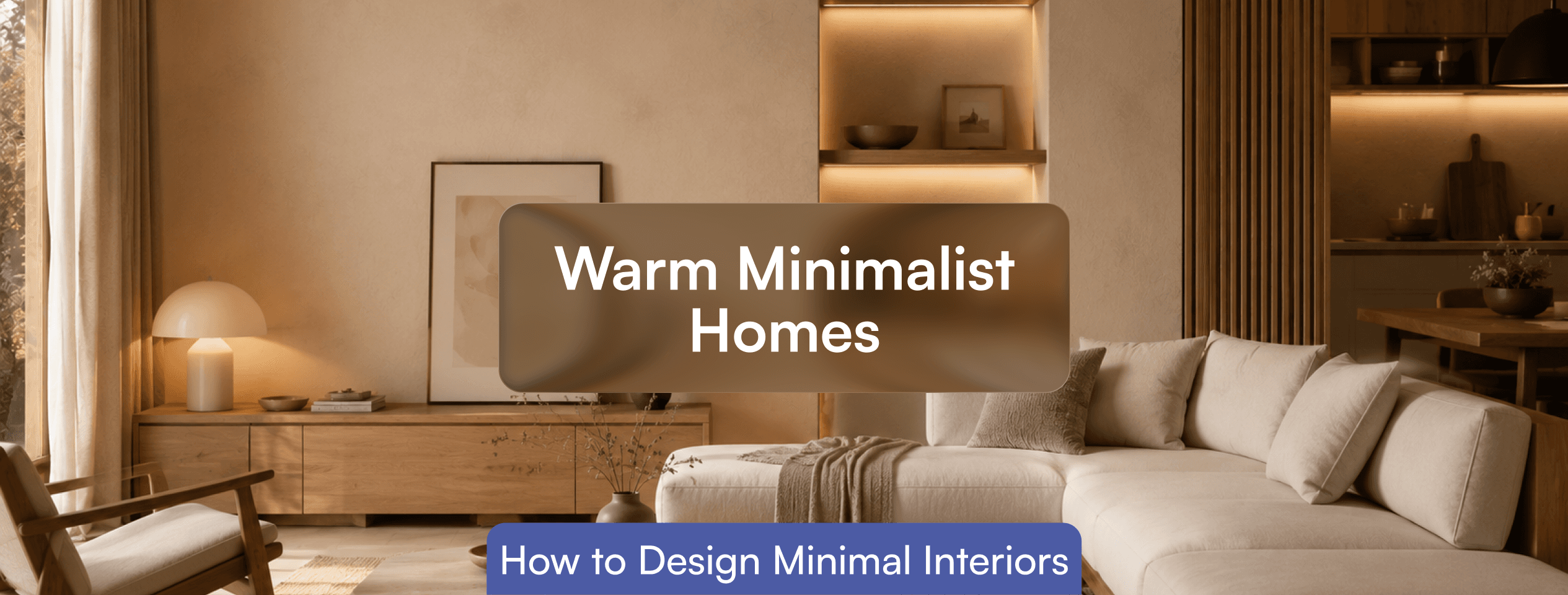
Warm minimalist interior design keeps the reduced clutter and clean lines of standard minimalism, but replaces cool whites and grays with natural materials, warm neutral tones and layered texture. It is achieved by pairing a restrained furniture count with materials that carry visible warmth, wood grain, wool, linen, warm-toned stone, and by using warmer, lower color temperature lighting instead of the flat white light that makes many minimalist homes feel clinical.
The confusion most people run into is thinking minimalism and warmth are opposites, so they either over-decorate to compensate for coldness or strip a room down until it feels unfinished. Neither is necessary. The two goals are resolved through material and lighting choices made early, not through adding more furniture at the end.
Classic minimalism became associated with sterile, showroom-like interiors for a specific reason: it was frequently executed using materials chosen for uniformity, painted drywall, engineered stone in flat uniform tones, cool white lighting, rather than materials chosen for texture and warmth. None of that is required by minimalism itself. Reduction in quantity does not require reduction in material character, and the coldness readers associate with minimalist homes is a materials decision, not an unavoidable consequence of having less in the room.
The market has been correcting for this directly. 1stDibs' 2026 Designer Trends Survey, based on 468 design professionals worldwide, found that 33 percent of designers now cite chocolate brown as their top anticipated color for 2026, up from 17 percent in 2022, while cool gray palettes continue to lose ground. That is a measurable move away from the cold-toned neutrals that defined the previous decade of minimalist interiors.
Warmth in a minimal interior comes from three material decisions, not from adding more objects. Wood left with visible grain and a low sheen, rather than painted or heavily lacquered, reads as warmer because the eye can register natural variation in the surface. Textiles matter more than most minimalist briefs account for: a single wool or boucle throw and a linen upholstery weave introduce tactile warmth without adding visual clutter, since texture reads as warmth even in a strictly limited color palette. Warm-toned stone and plaster, in ochre, terracotta or warm gray ranges rather than cool blue-gray, carry the same effect on hard surfaces that fabric carries on soft ones.
We go deeper into how these material decisions shift across different architectural and interior styles in our guide to interior design styles for luxury homes in South India, which covers where warm minimalism overlaps with and differs from other current styles.
A financial note worth including here natural materials chosen for warmth generally cost more upfront than a painted or laminate equivalent, but hold their appearance over a longer ownership period. Renovation research from Houzz has found that a majority of homeowners expect to stay in a home for over a decade, which is long enough for a natural material's higher initial cost to be justified against a synthetic finish that dates or needs replacing sooner.
Color temperature, measured in Kelvin, is arguably the single most underused lever in warm minimalist design. Light in the 2700K to 3000K range reads as warm and residential, close to candlelight or an incandescent bulb, while anything above 4000K reads as cool, clinical, and closer to office or retail lighting. A room finished entirely in warm materials can still feel cold if it is lit with a 4000K fixture, and a simpler, less expensive material palette lit correctly at 2700K will read warmer than an expensive one lit wrong.
Layering matters as much as temperature. A single ceiling-mounted fixture, however warm its rating, flattens a room and removes the shadow and contrast that make a space feel considered rather than showroom-lit. At minimum, a warm minimalist room needs an ambient source, a task source, and one accent source on separate switching, ideally on dimmers, so the room's mood can shift from daytime function to evening warmth without changing the furniture or finishes at all.
Because lighting temperature is difficult to judge from a spec sheet or a rendering, we set up comparative lighting samples at our experience center so clients can see the difference between a 3000K and a 4000K fixture against their actual material choices before committing.
There is a broader research basis for why this matters beyond aesthetics. A widely cited Human Spaces study of 7,600 office workers across 16 countries found that people in environments with more natural light and natural materials reported 15 percent higher wellbeing and 15 percent higher creativity. The study was conducted in workplace settings, but the underlying principle, that natural light and material warmth measurably affect how people feel in a space, applies just as directly to a home as it does to an office.
These three styles get used interchangeably online, which causes real confusion when a client references one and means another. Quiet luxury is primarily a materials and craftsmanship statement, restraint used to signal quality rather than cost, and tolerates a richer, more layered material palette than warm minimalism typically uses. Japandi merges Japanese and Scandinavian design principles specifically, and carries stronger rules around joinery, low furniture profiles and a narrower, more deliberate color range than warm minimalism requires. Warm minimalism is the broadest of the three: it is less a defined aesthetic system and more a correction, taking standard minimalism's restraint and fixing its most common failure point, an absence of warmth, without adopting the more specific material or cultural rules the other two styles carry.
Understanding this distinction matters practically. A client asking for warm minimalism who is shown a strict Japandi scheme, or a heavily bookmatched quiet luxury material palette, is being shown a different, more expensive, more restrictive brief than the one they actually asked for.
A warm minimalist room is not simply a normal room with fewer things in it. Storage has to be planned to disappear, concealed joinery rather than open shelving carrying visual clutter, so that what remains visible is limited by design rather than by whatever did not fit in a cupboard. Furniture count should be set by function, one seating arrangement sized correctly for how the room is actually used, not reduced arbitrarily until the room feels sparse. Getting this wrong in either direction, over-furnishing to compensate for a cold material palette, or under-furnishing until a room feels unfinished, is the most common execution failure in this style.
Decide your lighting temperature and your primary two or three materials before selecting any furniture, since furniture decisions are reversible while a lighting circuit and a material specification are not. Choose one or two textiles, a rug and a throw or upholstery weave, that will carry warmth across an otherwise restrained palette, and specify every light fixture in the 2700K to 3000K range rather than defaulting to whatever a contractor stocks.
If you want material sourcing, lighting design and layout resolved together under one accountable team, our turnkey interior design service is built around exactly this kind of coordinated, detail-dependent project.
Standard minimalism is defined by reduced quantity, however that reduction is executed. Warm minimalism adds a specific requirement: the materials and lighting used have to read as warm rather than cool, through natural wood, warm neutrals, texture and lower color temperature lighting.
Most often because of lighting temperatures above 4000K, a lack of textile layering, or materials chosen for uniformity rather than natural variation. Color palette alone does not determine warmth.
No. Japandi follows specific Japanese and Scandinavian design rules around joinery and furniture profile, and quiet luxury is primarily a materials and craftsmanship statement. Warm minimalism is broader and less rule-bound than either.
Generally 2700K to 3000K for most living spaces, which reads as warm and residential. Anything above 4000K tends to read as cool and clinical, regardless of the materials in the room.
Natural materials and layered textiles typically cost more upfront than painted surfaces and engineered uniform finishes, but they generally last longer and age better, which changes the calculation over a typical decade-plus ownership period.
Warm minimalism succeeds when restraint and material warmth are planned together from the start, not layered on at the end through extra furniture or accessories. The homes that get this right are the ones where lighting temperature, material choice and storage planning were resolved before a single piece of furniture was selected.
If you are planning a home and want to work through a warm, minimal material and lighting palette suited to it, professional interior designers in Coimbatore can help translate the concept into practical material, lighting and space-planning decisions. Book a free consultation with R Space to discuss your requirements.