
Mr. K.C. Kailasam - 04 Sept 2026
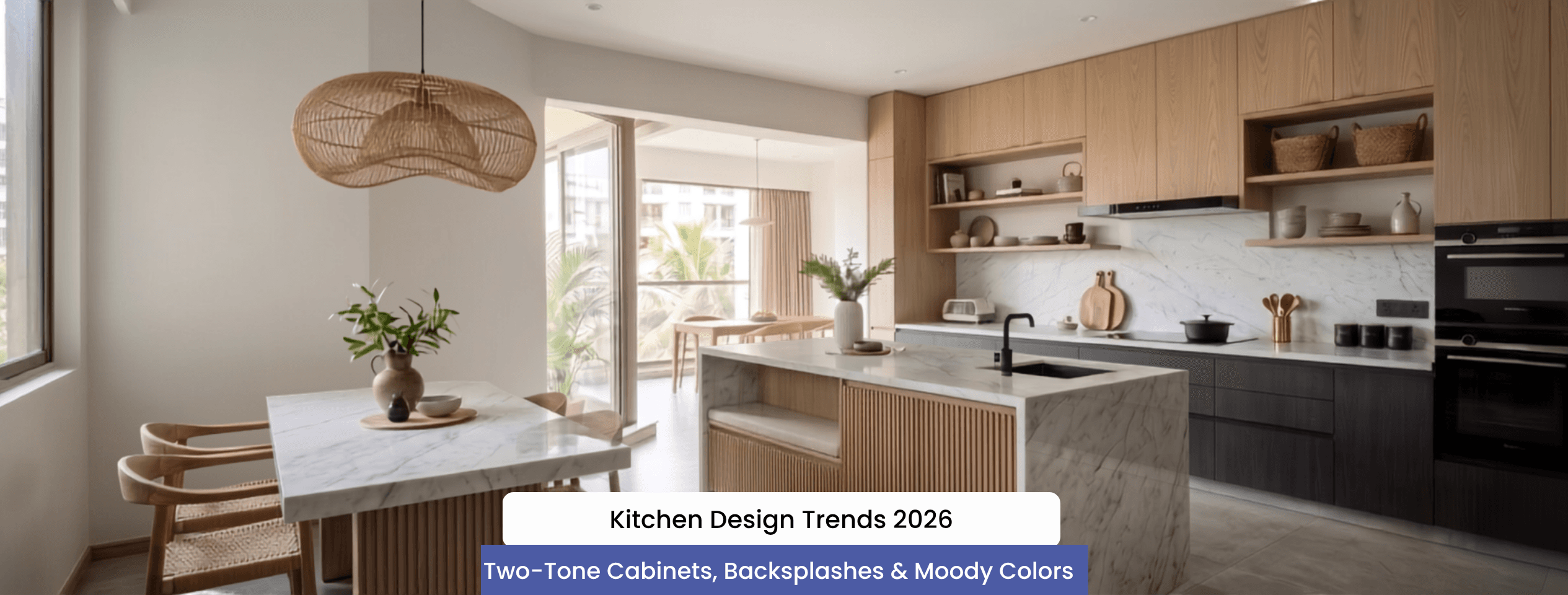
Every kitchen consultation at R Space now begins the same way: a phone full of screenshots. A two-tone cabinet photo saved from an interior design page. A slab backsplash cut from a single block of stone, without a single grout line in sight. A cabinet colour so deep the client asks, twice, whether it will feel too dark once the kitchen is actually cooking rice and sambar every day. Cabinet colour, backsplash, and overall palette have become the real starting point for kitchen conversations in 2026, ahead of layout, storage, or even appliances. This is not a trend roundup lifted from international mood boards. It is a working breakdown of what two-tone cabinetry, statement backsplashes, and moody colour palettes mean once you have to execute them, in real Coimbatore and Erode homes, with real kitchen exhaust requirements, real budgets, and daily South Indian cooking loads. Having delivered residential interiors for over three decades under Royal Furnitures and R Space, we know which of these Kitchen Design Trends 2026 hold up in a working kitchen and which need adapting before they leave the mood board. Kitchen renovation has quietly shifted from a purely cosmetic decision to a functional one. In the United States, the 2026 Houzz Kitchen Trends Study found that dissatisfaction with an outdated look remains the top renovation driver at 41 percent, but kitchen dysfunction has climbed to 38 percent, nearly closing the gap. Cabinet upgrades now feature in 84 percent of renovations, making cabinetry, not countertops or appliances, the single most consistent line item in a kitchen remodel. The National Kitchen & Bath Association's 2026 Kitchen Trends Report adds a useful data point for anyone weighing moody, dramatic colour schemes: 87 percent of design professionals surveyed named statement lighting a defining trend for the year, and the panel was unanimous that lifestyle-driven layouts will keep growing over the next three years. Read together, these two studies say something practical: colour and cabinetry are getting bolder, but only because lighting design and layout are working harder behind the scenes to support them. That relationship, bold finishes paired with disciplined lighting and planning, is the thread running through every trend in this guide. For homeowners comparing these global trends against real Indian execution, our guide to kitchen interior design ideas covers layout and storage planning in more depth. A two-tone kitchen uses two distinct cabinet colours or finishes within the same space, most commonly a lighter shade on the upper cabinets with a deeper tone below, or a contrasting finish reserved for the island alone. The purpose is not decoration for its own sake. Two tones let a kitchen read as layered and custom-built without changing the layout, the carcass material, or the shutter profile, which is exactly why it has become the default request in 2026 rather than a niche upgrade. Two-tone cabinetry depends on three things working together: the kitchen's layout, its natural light, and hardware consistency. In an L-shaped or parallel kitchen, the contrast usually sits between upper and lower runs, since that boundary already exists structurally. In an island kitchen, the second tone typically lives on the island itself, turning it into the room's focal point. Kitchens with limited daylight, common in many Coimbatore apartments where the kitchen faces a service shaft rather than an open window, need the lighter tone placed on the uppers and near work surfaces, or the room reads heavier than intended. The advantages are real and go beyond aesthetics. A two-tone scheme hides daily wear better than a single flat colour, because the darker lower cabinets, the ones closest to spills, dal splashes, and daily handling, mask marks that would show immediately on an all-white run. It also gives designers a way to make a modest, straight-line modular kitchen feel considered, without the cost of a fully custom layout. The limitation is discipline. Two tones without a shared connecting element, usually the hardware finish or the countertop, look unfinished rather than deliberate. A single hardware finish, whether unlacquered brass, matte black, or brushed steel, used consistently across both cabinet colours is the detail that separates a two-tone kitchen that looks designed from one that looks like leftover stock. On a recent apartment project we executed through our modular kitchen design service, we paired a warm off-white matte upper run with walnut-finish lower cabinets and a matching walnut strip on the island edge. The repetition of that one wood tone in three places, rather than three unrelated finishes, is what kept a fairly compact kitchen from feeling visually busy. A statement backsplash treats the wall behind the hob and sink as a design feature rather than a practical afterthought. Where a standard backsplash exists purely to protect the wall from splashes and oil, a statement backsplash is chosen for pattern, veining, or material first, protection second. The leading options in 2026 are full-height slab stone or engineered quartz with minimal seams, hand-glazed artisanal tile in irregular, textured finishes, and vertical subway layouts that break up the horizontal lines a two-tone cabinet scheme already creates. A backsplash cannot be chosen in isolation. Its material and pattern need to answer to three other decisions already made in the kitchen: the countertop material, the cabinet colour, and the exhaust hood design, since a large hood often interrupts exactly the part of the wall a statement backsplash is meant to showcase. Engineered quartz has become the most requested backsplash material internationally for a practical reason, not just an aesthetic one. The 2026 Houzz UK Kitchen Trends Study recorded engineered quartz splashbacks rising 13 percentage points year on year to a 36 percent share, ahead of glass, acrylic, and ceramic tile, largely because it resists staining without the sealing maintenance natural stone requires. That maintenance question matters more in an Indian kitchen than in most Western ones. Daily tempering, or tadka, with hot oil and mustard seeds throws fine grease droplets several feet from the stove, and turmeric-based gravies stain porous grout almost instantly if left unsealed. Natural marble and handmade zellige tile look extraordinary in photographs, but both are porous and need a proper sealant reapplied on a schedule, not a one-time application, to hold up behind an Indian hob. Engineered quartz slabs and large-format porcelain slabs give a similar high-end, minimal-seam look with none of that ongoing sealing requirement, which is why we now recommend them ahead of natural stone for the cooking zone specifically, reserving natural stone for lower-splash areas like a wet bar or coffee station. The advantage of a statement backsplash over other trend elements is that it is comparatively easy to update later. A cabinet colour is a decade-long commitment; a backsplash can often be replaced in a single-wall project without touching the rest of the kitchen. The limitation is cost concentration: a full-height slab backsplash behind an island hob can rival the cost of the cabinetry itself if the material is imported natural stone rather than a locally fabricated engineered surface. A moody kitchen palette replaces the bright white or light grey base most Indian kitchens defaulted to for a decade with deeper, richer tones: charcoal, ink blue, bottle green, or a wine-toned burgundy. The appeal is not simply that dark is fashionable. Deeper tones read as more permanent and considered, and practically, they hide fingerprints, water spots, and daily handling marks far better than a matte white shutter does under constant use. Moody colour depends almost entirely on lighting design, which is why the NKBA statistic on statement lighting matters here directly. A charcoal or navy cabinet run under a single centre-ceiling light looks flat and can genuinely make a small kitchen feel smaller. The same colour under layered lighting, under-cabinet task lighting at the counter, a warm accent strip inside open shelving, and general ambient light from above, reads as rich rather than heavy. This is the single most common gap between a moody kitchen that photographs beautifully and one that actually functions well for daily cooking: the lighting plan was treated as an afterthought instead of being designed alongside the colour. Moody cabinetry also depends on a lighter counterweight elsewhere in the room, usually the countertop, the backsplash, or the ceiling. A fully dark kitchen from floor to ceiling with no light-reflecting surface will absorb light rather than bounce it around the room, which is a real constraint in Coimbatore apartments where kitchens are often the smallest, least daylit room in the plan. The advantage of a well-executed moody kitchen is longevity; muted, earthy dark tones age better than bright trend colours because they read as intentional rather than seasonal. The limitation is that they demand more from the surrounding design, lighting, reflective surfaces, and a lighter secondary tone, to avoid the space feeling closed in. On projects where a client wanted a deep bottle-green island in an otherwise compact kitchen, we kept the perimeter cabinetry in a warm white and added a continuous LED strip beneath the wall units. The green reads as a deliberate accent rather than a colour that swallows the room, precisely because it is balanced rather than applied everywhere. The mistake we see most often, in both DIY planning and in briefs handed to less experienced contractors, is treating cabinet colour, backsplash, and overall palette as three separate shopping decisions. In a well-designed 2026 kitchen, they function as one system, with hardware finish and countertop material acting as the connective tissue between them. A dependable way to think about it: choose one dominant tone for the cabinetry, one contrasting or grounding tone for the second cabinet finish, one neutral surface (usually the countertop or a plain-slab backsplash) to let the eye rest, and one metal finish repeated on every handle, tap, and light fixture in the room. Charcoal lower cabinets with a warm white upper run, a fluted or gently veined marble-look backsplash, and unlacquered brass hardware is one dependable 2026 combination; navy island cabinetry with white perimeter units, a plain engineered-quartz backsplash, and brushed steel hardware is another. Both work because each element has exactly one job, rather than every surface competing to be the star of the room. Most kitchen trend reports are written from a Western context: gas or induction cooking with limited oil, drier climates, and kitchens designed as much for entertaining as for daily cooking. Executing the same trends in Tamil Nadu requires a few adjustments that rarely appear in international articles, and this is where hands-on execution experience matters more than the trend photo itself. Coimbatore's humidity, combined with daily steam from pressure cookers and prolonged stovetop use, puts real stress on cabinet finishes. PU-painted shutters, popular for the flat, saturated look moody colours need, perform well against humidity but require a genuine multi-coat PU process rather than a single-coat shortcut, or the colour dulls and chips within a couple of years. Laminate finishes in dark tones are a more budget-friendly and humidity-tolerant alternative, though they show water spots more readily than PU. Behind any statement backsplash or two-tone shutter, the carcass material determines how long the kitchen actually lasts. BWP-grade (boiling waterproof) plywood or HDHMR boards are essential in a South Indian kitchen given routine exposure to steam and occasional water contact near the sink, regardless of how premium the visible cabinet colour or backsplash material looks. A deep, moody colour scheme paired with inadequate chimney or exhaust capacity will show smoke and oil residue far faster than a light-coloured kitchen would, simply because dark matte surfaces make grease film more visible at close range, not less. We size the chimney and exhaust capacity to the household's actual cooking style, frequent tempering, extended simmering, roasting papads, before finalising a dark palette, not after. This is the core of what makes R Space a trusted name among interior designers in Coimbatore: we do not simply reproduce a trend photo, we test it against Tamil Nadu's climate, cooking habits, and household use before it goes into a client's drawing. Not every element of a trend-forward kitchen carries the same cost weight, and understanding where the money actually goes helps homeowners prioritise correctly. Two-tone cabinetry adds a modest cost over a single-colour kitchen, mainly because it introduces a second finish SKU and slightly more precise execution at the seam between colours, but it does not meaningfully change the base cabinetry budget. Backsplash cost varies far more widely: engineered quartz and large-format porcelain slabs cost less to fabricate and install than imported natural stone, because fewer seams mean less cutting, less wastage, and simpler transport, while still delivering the minimal-seam, high-end look homeowners want. Moody colour, delivered through PU paint rather than laminate, is usually the more expensive route to the same visual result, since multi-coat PU finishing is a slower, more labour-intensive process than laminate pressing. A practical sequencing approach: commit the larger budget to cabinetry, since it is the least reversible decision and the one most Indian homeowners keep for 12 to 15 years, and treat the backsplash as the easiest element to phase in with a mid-range material now and an upgrade later, since it is the one component of this trio that can be replaced without disturbing the rest of the kitchen. Mismatched undertones between the two cabinet colours: a cool-toned grey lower run against a warm white upper run reads as a mistake, not a design choice, even though each colour looks fine alone. Skipping under-cabinet and accent lighting when choosing a moody palette, then being surprised the finished kitchen feels darker than the reference photo, which was almost certainly shot under professional lighting. Selecting a porous natural stone backsplash for the cooking zone without budgeting for ongoing sealing, then dealing with turmeric and oil stains within the first year. Ordering cabinet colour from a small digital swatch rather than a physical sample viewed inside the actual kitchen, where the room's own light temperature changes how the colour reads. Choosing a heavily textured, artisanal-tile backsplash directly behind the hob, where its uneven surface becomes genuinely difficult to degrease compared with a flat slab or glazed tile. Trend research is the easy part; execution is where most kitchens fall short of the reference photo. Our process starts with a single palette board for cabinetry, backsplash, countertop, and hardware finish, reviewed together before any material is ordered, exactly the system described earlier in this guide. Because R Space, by Royal Furnitures, manufactures in-house and holds ISO 9001 and ISO 14001 certification, the same team that finalises the palette also controls fabrication tolerances, PU coat counts, and edge finishing, rather than handing the design off to a separate execution vendor. If you are planning a kitchen renovation around these 2026 trends, our modular kitchen service page outlines material options, storage configurations, and the consultation process in detail, and our design team can walk through which combinations suit your kitchen's light, layout, and cooking habits before you commit to a colour. The Kitchen Design Trends 2026 conversation is really a conversation about restraint: one cabinet palette used with intention across two tones, one backsplash chosen to answer to the materials around it, and one deeper colour supported by lighting that was planned alongside it rather than added afterward. Executed this way, in a South Indian kitchen with the right core material and ventilation behind the finish, these trends outlast the year they were photographed for. R Space has been executing residential interiors from Coimbatore and Erode. If you would like these trends translated into a plan for your own kitchen, you can explore our home interior design services or book a design consultation directly with our team. Two-tone cabinetry is the most requested cabinet trend for 2026, typically pairing a lighter upper run with a deeper lower tone or a contrasting island colour. Wood-toned finishes have also overtaken plain white as the single most requested cabinet colour internationally, according to the 2026 Houzz Kitchen Trends Study. Two-tone cabinets have moved from a niche choice to a mainstream default in 2026 rather than fading out. The detail that keeps a two-tone kitchen from dating quickly is restraint: one connecting element, usually the hardware finish, repeated across both colours, rather than several unrelated finishes competing for attention. Engineered quartz and large-format porcelain slabs are the most practical statement backsplash materials for Indian kitchens, since they resist oil and turmeric staining without the ongoing sealing that natural marble or handmade zellige tile require behind a daily-use Indian hob. Dark cabinetry can make a small, poorly lit kitchen feel closed in, but the colour itself is rarely the real cause. A moody palette paired with layered task and accent lighting, plus one lighter surface such as the countertop or backsplash, reads as rich rather than cramped even in a compact kitchen. Prioritise cabinetry first, since it is the least reversible decision and typically lasts 12 to 15 years. Treat the backsplash as the most flexible line item, since it can be upgraded later without disturbing the rest of the kitchen, and budget extra for multi-coat PU finishing if you want a moody colour rather than a laminate substitute.What Is Actually Changing in Kitchen Design
Two-Tone Cabinets: The Anchor Trend
Statement Backsplashes: From Filler to Focal Point
Moody Colours: Why Homeowners Are Choosing Depth Over Brightness
How Two-Tone Cabinets, Backsplash, and Colour Work as One System
Adapting 2026 Kitchen Trends to Indian Homes and Coimbatore's Climate
Heat and humidity affect finish choice
Core material matters more than the visible finish
Ventilation has to be designed before the colour is chosen
Budget Planning for 2026 Kitchen Trends
Common Mistakes Homeowners Make Chasing 2026 Kitchen Trends
How R Space Executes These Trends
Final Thoughts
Frequently Asked Questions
What is the most popular kitchen cabinet trend for 2026?
Are two-tone kitchen cabinets still in style, or is it already dated?
What is the best backsplash material for Indian kitchens in 2026?
Do dark or moody kitchen cabinets make a small kitchen feel smaller?
How should I split my kitchen budget across cabinets, backsplash, and colour?