
Mr. K.C. Kailasam - 12 Aug 2026
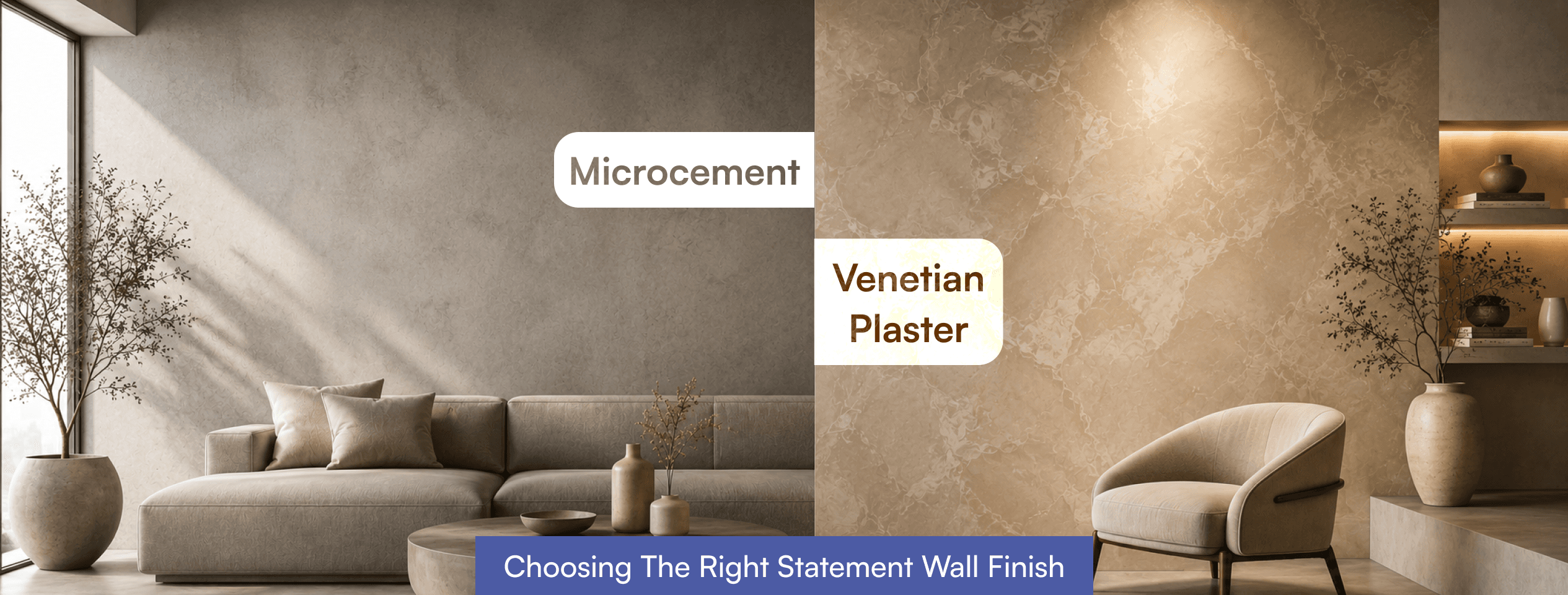
Microcement and Venetian plaster get grouped together constantly, and it's easy to see why. Both produce a seamless, joint-free wall with a handcrafted texture, both photograph beautifully, and both are marketed under the broad umbrella of "statement wall finishes." But the two come from completely different material families, behave differently on site, and suit different rooms. Choosing the wrong one means redoing a feature wall within two years. Choosing correctly means a finish that ages well and still looks considered a decade later. The confusion is understandable. At a glance, a polished microcement wall and a burnished Venetian plaster wall can look almost identical in a photograph. What separates them shows up only once the material is on the wall and living with daily use, humidity, and touch. This guide breaks down what each material is actually made of, where it performs and where it fails, and how to decide between them for a specific wall in a specific room. For a broader look at how these materials sit alongside stone, wood and other premium options, our luxury interior materials guide is a useful companion read. Microcement is a cement based coating strengthened with water-based resins, mineral pigments and, in most professional systems, a fibreglass reinforcing mesh. It is applied by hand in several thin layers, typically no more than 2 to 3 mm as a complete system once primer, base coat, finish coat and sealer are accounted for. That thinness is deliberate. A traditional cement screed needs several centimetres to hold together, but microcement is engineered to bond directly to an existing surface, which means it can go straight over tile, concrete, plywood or drywall without any demolition. The purpose of microcement in a project is almost always practical as much as aesthetic. It solves the problem of joints. Tiled bathrooms and kitchens accumulate grout lines that stain and require re-sealing; a microcement surface has none, which is why it has become the default choice for walk-in showers and kitchen backsplashes in the projects we deliver. Its dependency is surface preparation. Microcement will faithfully replicate every crack, dip and unevenness in the substrate beneath it, so a poorly prepared wall shows through the finish rather than being hidden by it. Its advantages are durability and range. Once sealed with a polyurethane or epoxy topcoat, microcement resists water, abrasion and daily scuffing well enough to be specified on floors, staircases and countertops, not just walls. Its limitation is that it demands a trained applicator. Multiple layers, correct drying windows between coats, and precise sanding are unforgiving of shortcuts, and a rushed job tends to hairline crack within the first monsoon season in humid Indian climates. Venetian plaster is a lime-based finish made from slaked lime putty blended with finely ground marble dust. It is applied with a steel trowel in several thin coats, then compressed and burnished so the marble particles catch and reflect light from just beneath the surface. That is what produces its signature glow, a depth that a flat painted wall or even a microcement wall cannot fully replicate, because light is entering the material rather than bouncing off it. The technique predates modern microcement by centuries and is generally traced to Roman lime-rendering practices, later refined and popularised in Renaissance Venice, which is where its name comes from. Its purpose in a contemporary interior is almost entirely aesthetic. It is chosen for the sense of depth and material history it brings to a formal living room, a lobby, or a bedroom feature wall, spaces where nobody is going to touch the surface with wet hands or drag a suitcase across it. Its dependency, like microcement, is the substrate, but Venetian plaster is more forgiving of minor imperfections since its multiple polished coats build up a slightly softer surface. Its advantage is being genuinely low in volatile organic compounds, since the core ingredients are mineral rather than synthetic. Indoor air quality guidance from the U.S. Environmental Protection Agency notes that concentrations of many common VOCs run consistently higher indoors than outdoors, which is one reason lime-based finishes are gaining attention in bedrooms and nurseries. Its limitation is moisture. Left unsealed, Venetian plaster absorbs water and stains, so it stays out of showers and splash zones by default. Every practical difference between these two finishes traces back to one fact: microcement is a cement composite and Venetian plaster is a lime composite. Cement cures harder and bonds more aggressively to a wider range of substrates, which is why microcement can go on floors and Venetian plaster generally cannot. Lime stays breathable and slightly softer, which is why Venetian plaster develops that glassy, marble-like translucence that cement-based finishes only approximate. Neither material is an upgrade on the other. They are built to do different jobs, and the aesthetic overlap between them is largely coincidental. This is also where most articles stop short. The real decision point is not which finish looks better in a photograph, since both photograph beautifully under the right light. It is which finish matches the way that specific wall will be used, cleaned and touched over the next ten years. Bathrooms and walk-in showers, where a sealed surface handles constant moisture without grout to maintain Kitchen backsplashes and countertops, where heat and daily wiping down are routine Entryway and living room floors, where a continuous, joint-free surface reads as calm and expansive Compact apartments being renovated without raising floor height, since it adds only a few millimetres Formal living rooms and dining walls, where the light-catching depth becomes a genuine focal point Bedroom feature walls, where the low-VOC composition and soft glow suit a restful space Lobbies, reception walls and study rooms, where a classical or heritage tone is the design intent Ceilings, an application microcement is rarely specified for due to its weight and application angle If the brief calls for a stone-like wall without the cost of slab material, it is worth comparing both against natural options first. Our breakdown of Italian marble versus travertine covers how those stones behave in similar rooms, and is a useful reference before committing to a plaster or cement finish instead. Microcement is the stronger performer under physical stress. Its cement base resists cracking and impact better than a lime-based coating, and a properly sealed system tolerates standing water, cleaning chemicals and foot traffic. This is why hotels and commercial kitchens in India increasingly specify it for high-footfall zones, not just residential bathrooms. Venetian plaster holds up well against everyday contact but is not built for abrasion or moisture. A hallway wall that gets brushed by bags and shoulders daily will burnish and shine unevenly over time, sometimes attractively, sometimes not. Sealing with beeswax or a water-based topcoat extends its life and improves stain resistance, but it will never match microcement's tolerance for a wet mop or a splashing toddler. Microcement installation typically runs three to five days for a wall and closer to a week for a floor, since each layer needs time to cure before the next goes on and before final sealing. The process involves a primer coat, one or two base coats often reinforced with fibreglass mesh, a finish coat, and a protective sealer, with light sanding between stages. Skipping the sanding step is the single most common cause of visible trowel marks in a finished microcement wall. Venetian plaster generally involves three coats applied and burnished with a steel trowel, and needs less sanding overall, which is why some contractors describe it as marginally more straightforward, though it is still a skilled trade rather than a weekend project. Both finishes are unforgiving of humidity during application, and in coastal or monsoon-heavy regions of India, scheduling around weather is as important as scheduling around the applicator's calendar. Pricing for both finishes depends heavily on wall area, substrate condition, and how much surface preparation the existing wall needs, so any number quoted without seeing the site should be treated as a rough guide rather than a final figure. As a general pattern, resurfacing an already tiled bathroom is often more economical with microcement, since it eliminates tile removal entirely. For a smaller decorative feature wall on a sound plaster substrate, Venetian plaster can work out more cost-effective, particularly when the wall does not need floor-level durability. Where budget is a genuine constraint, it is worth weighing both against other statement-wall materials before deciding. Our comparison of limestone versus marble and our guide to onyx marble wall design both cover natural stone alternatives that sit in a similar visual territory but come with a different cost and maintenance profile. Microcement is low maintenance by design. Routine cleaning needs only water and a neutral soap, and a sealed surface typically only needs its topcoat refreshed every two to three years under normal residential use, longer in low-traffic areas. It does not need waxing, polishing or specialist attention beyond that resealing cycle. Venetian plaster asks for a little more care, particularly at high-touch points like door surrounds and hallway corners. Reapplying wax periodically keeps its sheen even and protects against staining. Done well, this maintenance is not a burden. Many designers, ourselves included, consider a well-maintained Venetian plaster wall to actually improve with age as the surface develops a deeper patina, something a purely synthetic finish cannot offer. The visual distinction comes down to how each surface interacts with light. Microcement has a flat, even matte-to-satin character. It absorbs light rather than reflecting it back with variation, which is exactly why it reads as calm, modern and industrial. Venetian plaster does the opposite. Its polished, semi-translucent layers let light penetrate slightly before bouncing off the embedded marble particles, producing the soft glow and tonal shift associated with genuine marble or onyx. This is the detail most comparison articles skip. If a client wants a wall that changes character through the day, brighter and more luminous at noon, softer and warmer at dusk, Venetian plaster delivers that behaviour naturally. Microcement stays visually consistent regardless of light conditions, which suits spaces where a controlled, unchanging backdrop is the goal, such as a home office or a kitchen designed around task lighting. Humidity, seasonal temperature swings and the prevalence of RCC or brick-and-plaster construction all affect how these finishes perform locally. Microcement's flexibility and water resistance generally make it the safer default for bathrooms and kitchens across most Indian cities, since monsoon humidity is a real long-term stressor on any wall finish. Venetian plaster performs best in climate-controlled interior rooms rather than balconies or semi-open verandas, where humidity swings can affect its curing and long-term finish. For homeowners weighing climate-appropriate materials more broadly, our travertine stone guide for India's climate and lifestyle walks through similar considerations for natural stone, and is worth reading alongside this comparison if flooring is also part of the brief. Start with how the wall will actually be used, not how it will look in a rendering. A wet wall, a floor, or any surface that will be cleaned frequently points toward microcement. A dry, low-traffic feature wall where depth and warmth matter more than resistance to water points toward Venetian plaster. Mixed-use spaces, such as an open kitchen that flows into a living area, often benefit from using both: microcement on the working wall behind the counter, Venetian plaster on the adjoining living room wall where it is purely decorative. If timber flooring is also part of the room's palette, both finishes pair differently with wood tones. Warmer, honey-toned floors like those covered in our oak hardwood flooring guide tend to sit beautifully against the warmth of Venetian plaster, while the cooler, more graphic tone of engineered wood flooring often complements microcement's minimal, industrial character more closely. This is exactly the kind of decision that benefits from seeing the actual substrate, lighting conditions and usage pattern of a room before committing. Our home interior design service in Coimbatore involves this assessment as a standard part of material selection, rather than specifying a finish from a catalogue photograph alone. Across the projects we deliver, the recurring mistake is treating microcement and Venetian plaster as interchangeable style choices rather than performance decisions. We start every wall finish conversation by walking the site, checking substrate condition, moisture exposure and how the family actually lives in the space, then match the material to that reality. A feature wall that looks identical to a client's inspiration photo but fails within eighteen months is not a successful outcome, regardless of how good the initial installation photographs looked. You can explore more of our material comparisons, including best marble for luxury homes, on the R Space Studio blog, or reach out directly if you are weighing these finishes for an active project. Neither finish is objectively better. Microcement earns its place through resilience and range, holding up on floors, counters and wet walls where Venetian plaster cannot follow. Venetian plaster earns its place through depth and warmth, a quality that comes directly from its lime and marble dust composition and cannot be fully replicated by any cement-based alternative. The right choice is the one that matches how a specific wall, in a specific room, will actually be lived with. Not consistently. Microcement often costs less overall when it is applied directly over existing tile, since there is no demolition involved. Venetian plaster can be more economical for a single decorative wall on a substrate that is already plaster-ready. The final number depends on wall condition and area more than on the material itself. It can be used on dry walls away from direct water contact, such as an accent wall behind a vanity, provided it is properly sealed. It is not recommended for shower enclosures or any surface that will see standing water, where microcement is the more reliable choice. A correctly installed microcement system with fibreglass reinforcement and proper substrate preparation resists cracking well. Hairline cracking usually traces back to skipped drying time between coats, an unprepared substrate, or applying it over a substrate that is still moving structurally. Both can last well beyond a decade with correct maintenance. Microcement holds its finish with a resealing cycle roughly every two to three years in used areas. Venetian plaster, if kept dry and occasionally waxed, tends to develop a deeper, more attractive patina rather than visibly ageing. Microcement is specifically engineered to bond over sound existing tile, concrete or drywall, which is one of its biggest practical advantages during a renovation. Venetian plaster needs a properly prepared, primed substrate and is less forgiving of glossy tile or unstable paint layers underneath.What Microcement Actually Is
What Venetian Plaster Actually Is
The Core Difference: Composition Decides Everything Else
Microcement vs Venetian Plaster at a Glance
Where Each Finish Performs Best
Rooms suited to microcement
Rooms suited to Venetian plaster
Durability, Water Resistance and Daily Wear
Application Process and Project Timeline
Cost Considerations
Maintenance and Long Term Ownership
Aesthetic Character and How Light Behaves on Each
A Note on Indian Climate and Substrates
Which One Should You Choose
How R Space Approaches Statement Wall Finishes
Conclusion
Frequently Asked Questions
Is microcement more expensive than Venetian plaster?
Can Venetian plaster be used in a bathroom?
Does microcement crack over time?
How long does a microcement or Venetian plaster wall actually last?
Can these finishes be applied over existing paint or tile without removing it first?