
Mr. K.C. Kailasam - 04 Aug 2026
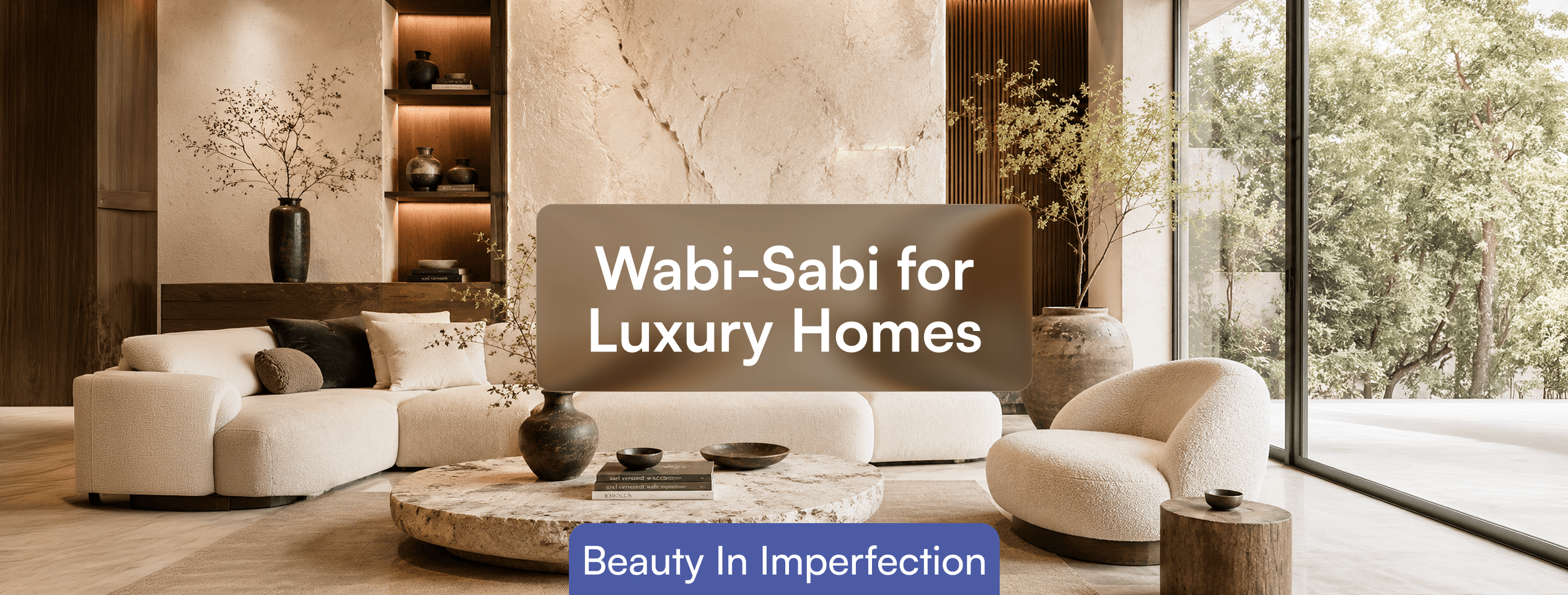
A home can cost a fortune to fit out and still feel cold, and the reason usually has nothing to do with the budget. It has to do with surfaces that carry no history. Walk through a well kept ryokan outside Kyoto and every surface reads under your fingers: a lime plastered wall with visible trowel marks, a cedar beam darkened unevenly by decades of woodsmoke, a ceramic bowl repaired with a visible seam of gold lacquer. Wabi sabi interior design is the discipline of building that same honesty into a home, at a level of craft that a luxury brief expects and a project manager can actually deliver on schedule. This piece walks through what the philosophy demands, where most articles stop short, and how it gets executed on a real site without turning into either sterile minimalism or staged shabbiness.
Wabi and sabi were originally two separate ideas in Japanese aesthetics. Wabi describes the quiet dignity of simplicity and modest living. Sabi describes the beauty that settles into an object as it ages, the patina on brass, the softened edge of a stone step. Combined, wabi sabi interior design became a way of building and furnishing spaces around the idea that nothing is finished, nothing is permanent, and nothing needs to be flawless to be beautiful.
This gets flattened online into a shopping list: a distressed side table, a linen throw, a crack left visible in a bowl. Those items can support the look, but they are not the design logic itself. The logic is about thoughtful design, material honesty, and evidence of process. A wall that shows the plasterer's hand is wabi sabi. A wall printed with a plaster effect wallpaper to fake that same texture is not, no matter how convincing it looks in a photograph. That distinction matters most at the luxury end, where clients can tell the difference and where the cost of getting it wrong is highest.
Wabi sabi grew out of Zen Buddhism and was refined through the Japanese tea ceremony, or chanoyu. In the fifteenth century the Zen priest Murata Juko began replacing the ornate Chinese tea instruments then in fashion with simpler, locally made pieces. Sen no Rikyu perfected this approach in the sixteenth century, designing tea rooms with deliberately low entrances that forced every guest, regardless of rank, to bow on the way in. Every material and dimension in that room served the philosophy of humility rather than a decorative agenda.
That history matters for a design brief because it clarifies what wabi sabi is actually optimizing for. It is not decoration layered onto a room after the fact. It is a set of decisions made at the planning stage, about proportion, material, and thoughtful design, that shape the room from the inside out. Portland Japanese Garden's account of this history is a useful reference if you want to see how directly the tea room's physical design was tied to the philosophy behind it, rather than treated as a separate styling exercise.
These four get treated as interchangeable in most articles, which causes real confusion at the design stage. Minimalism strips out visual noise in pursuit of clarity, and it usually prizes precision and symmetry, matched furniture pairs, straight edges and uniform finishes. Wabi sabi welcomes asymmetry and visible irregularity as the point, not a flaw to be corrected.
Japandi blends Scandinavian warmth with Japanese thoughtful design, and it is the closest relative to wabi sabi, but it tends to be more color-coordinated and produced with machined precision. Wabi sabi tolerates a level of irregularity that Japandi interior design typically smooths out during manufacturing. Rustic farmhouse style borrows raw materials for nostalgic effect and often layers them heavily with pattern and ornament. Wabi sabi restricts ornament and lets the imperfection of a single material carry the room.
The practical implication for a luxury brief is that a designer cannot simply write 'natural materials, imperfect finish' on a specification sheet. The tolerance for irregularity has to be defined explicitly, in writing, with reference samples. Otherwise a contractor trained to deliver flawless finishes will 'correct' the very texture the client is paying a premium for.
This is not a passing trend cycle. The Global Wellness Institute reports that the wellness real estate market reached 876 billion dollars in 2025, up from 151 billion in 2017, and is projected to more than double to 1.8 trillion dollars by 2030. Homeowners funding that growth are increasingly paying for how a space makes them feel, not just how it photographs.
There is a physiological basis for this shift. Research on biophilic and natural-material interiors, including peer-reviewed findings published via the National Institutes of Health, links exposure to natural textures and materials with measurable reductions in stress markers such as cortisol. That matters more than it sounds, since people in urban environments now spend up to ninety percent of their time indoors. A living room finished in machine perfect surfaces offers none of that restorative texture. A wabi sabi living room, done properly, offers it constantly, without the occupant having to consciously notice it.
At the luxury end specifically, we see clients who have already owned the polished, symmetrical version of a high-end home and are now paying a premium for the opposite: rooms that feel inhabited rather than staged for resale.
Four Japanese aesthetic principles do most of the practical work on a wabi sabi project. Each has a direct, specifiable translation into a luxury interior:
Kanso, simplicity: eliminate anything that does not earn its place. In practice, this means one statement piece per wall rather than a curated cluster of objects.
Fukinsei, asymmetry: avoid matched pairs. A single hand thrown basin sink instead of his and hers matching units communicates intention rather than budget constraint.
Shizen, naturalness: materials should read as themselves. A stone counter left honed rather than mirror-polished, timber left with visible grain rather than lacquered to a uniform sheen.
Datsuzoku, freedom from convention: break an expected pattern deliberately, such as leaving one section of a plastered wall unfinished and sealed rather than matched to the rest of the room.
These are not styling instructions to hand to a decorator at the end of a project. They need to be built into the space plan and material schedule from the first design meet, which is where an interior designer and architect need to be working from the same brief.he Material Palette That Makes or Breaks the Look
Four material categories carry almost every successful wabi sabi luxury interior:
Lime plaster or microcement walls, applied by hand so trowel variation stays visible rather than sanded flat.
Reclaimed or live edge timber, unlacquered brass, and blackened steel, all selected specifically because they are meant for natural aging rather than stay static.
Hand thrown ceramics, raw linen, and unbleached cotton, chosen for texture over pattern.
Natural stone such as travertine, kota, or limestone, left honed instead of polished to a mirror finish.
Every one of these materials depends on a craftsman who can execute controlled irregularity on purpose, which is a sourcing and labor decision, not a mood board decision. This is the part of a wabi sabi brief that most residential blogs skip entirely, and it is where our home interior design team spends the bulk of its planning time, matching the right artisan to the right finish before a single wall gets touched.
One reclaimed wood console rather than a matched furniture set. A lime-washed feature wall behind the seating. Upholstery in raw linen or undyed cotton. Avoid symmetric arrangements of chairs and side tables, which read as showroom staging rather than a lived in space.
Honed stone counters instead of polished quartz. Open shelving styled with hand-thrown crockery that is harmonious in tone but not identical piece to piece. Unlacquered brass fixtures, chosen deliberately because they darken with use rather than staying showroom bright.
A plastered headboard wall in place of an upholstered or lacquered one. Linen bedding in undyed or lightly dyed tones. A single asymmetric artwork or a seasonal branch arrangement rather than a gallery wall of framed pieces.
A carved stone basin, minimal hardware in a walk in shower, and natural ventilation prioritized over mechanical scent diffusion. Wabi sabi bathrooms tend to feel closer to a spa than a display case, which is the point.
Every one of these choices has a downstream effect on MEP and electrical planning. Unlacquered brass near a wet zone, for instance, needs a different maintenance specification than a lacquered equivalent, and that conversation has to happen at the planning stage, not after installation.
Most consumers treat wabi sabi as something you buy: a ceramic bowl here, a linen throw there. In a genuine high-end execution, the imperfection has to be engineered, not discovered on a shopping trip. Lime plaster's variation is achieved through a specific trowel technique and controlled drying conditions agreed with the applicator in advance, not left to chance. A live edge table is selected from timber logged and dried for particular grain characteristics, not pulled off a catalog page labeled 'rustic.'
This has a direct cost and schedule implication that gets left out of most articles on the topic. Hand-applied finishes and artisan made pieces take more labor hours than machine finished equivalents, and the project schedule has to account for curing and drying time that factory made finishes simply do not require. A construction project manager who has not planned for this will either blow the timeline or pressure the trades into rushing a finish that then reads as sloppy rather than intentional, which defeats the entire purpose of the brief.
Over distressing: forcing artificial wear, such as sandblasting new timber to fake age, breaks the honesty the whole philosophy depends on. Clients and guests can usually tell.
Too many competing textures: layering reclaimed wood, rough plaster, exposed brick, and heavy pattern in one room leaves it visually busy rather than calm, which is the opposite of the intended effect.
Flat, uniform lighting: wabi sabi textures need low, warm, directional light to read as intentional. Bright even lighting flattens texture and makes a considered finish look unfinished instead.
Skipping the maintenance conversation: patina only develops correctly if the client knows which finishes to leave alone, such as unlacquered brass and oiled timber, and which still need routine sealing, such as certain stones.
In a new build, plaster systems, stone honing, and joinery can be specified from day one, which gives the most control over the final result. In a renovation, the work is closer to editing than replacing: stripping over-polished floors back to a matte finish, swapping a symmetric fixture pair for a single artisan piece, and reworking the lighting plan before touching a single piece of furniture.
A full material and trade transition, covering plaster, stone, joinery, and lighting under one coordinated contract, avoids the sequencing gaps that cause the over-distressing and lighting mistakes described above. This is exactly the kind of multi-trade coordination our turnkey interior solutions team is built to manage, since a wabi sabi renovation touches almost every trade on site at once rather than one room at a time.
Space planning comes first, since organic beauty depends on generous negative space rather than a room filled with objects. Material sourcing and artisan matching happen next, followed by trade sequencing that protects drying and curing time in the schedule. As luxury home interior designers in Coimbatore, our team also considers how the selected materials, finishes and craftsmanship work together across the entire home. Our experience center has sample walls and material boards you can walk through. You can also read more about how we approach luxury interior design styles in general on our blog, and our about us page has more on the thirty years of execution experience behind these decisions.
It usually costs more in labor than a machine finished equivalent, since hand-applied plaster and artisan-made pieces take more skilled hours to produce. Material costs can be moderate, but the craftsmanship and schedule allowance for curing and drying push the overall budget closer to a premium finish package.
It works well in modern luxury homes when the irregularity is controlled and paired with clean architectural lines. The contrast between a precise structural shell and honestly imperfect finishes is often what makes the style read as high end rather than rustic.
Japandi blends Scandinavian warmth with Japanese thoughtful design and typically favors machined precision and coordinated color palettes. Wabi sabi tolerates more visible irregularity, asymmetry, and evidence of the maker's hand, which Japandi tends to smooth out.
Avoid high-gloss lacquers, mirror-polished stone, printed faux-texture wallpapers, and matched furniture sets. These read as manufactured perfection, which works against the philosophy's core idea of honest, aging material.
Unlacquered brass should be left alone to darken naturally rather than polished, which is where most of its character comes from over time. Lime plaster generally needs only light dusting and should not be sealed with a glossy topcoat, since that removes the texture the finish was chosen for. A short maintenance brief from your designer at handover prevents both from being 'corrected' by a well-meaning housekeeping team.
Wabi sabi interior design rewards a home that is planned for it from the outset, but it can be introduced carefully into an existing luxury home with the right sequencing. If you are weighing this direction for a current or upcoming project, get in touch with our team for a consultation, and we can walk through which parts of your home are the strongest candidates for this treatment before any material gets ordered.