
Mr. K.C. Kailasam - 28 Sept 2026
After detailing accent walls across close to a hundred living rooms over the years, one pattern shows up on almost every site visit, the client asks for a “feature wall” before anyone has worked out what problem that wall is meant to solve. An accent wall is not a decoration added at the end of a project. It is a decision about where a visitor's eye rests first, and it only works when it respects the room's proportions, the direction it faces, and the furniture that will eventually sit against it. India's decorative paint segment alone was valued at roughly USD 3.28 billion in 2024 and is growing at over 5% a year, largely on the back of home renovation spending in cities. That is a lot of money going into wall finishes, often without this basic sequencing in place.

Vertical reeded panelling behind a TV console or sofa back adds proportion to a wall that would otherwise look flat, and the grooves genuinely soften echo in rooms with hard flooring, which matters in most Indian apartments that use vitrified tiles rather than carpet. It works best on a wall free of structural beams or electrical conduit, since panelling has to sit flush. The trade off is maintenance, the grooves collect dust and need a soft brush vacuum attachment every few weeks, and factory-finish MDF panelling is far more humidity-stable in Indian climates than solid wood, which can warp over a monsoon season.

A hand-applied lime or clay plaster gives a wall depth that paint cannot replicate, because light catches the irregular surface differently through the day. It suits living rooms with good natural light, where the texture reads clearly rather than disappearing into shadow. The dependency is skilled labour: a mason unfamiliar with lime plastering will leave visible lap marks, and the surface needs three to five days of controlled curing before furniture goes back against it. In coastal or high-humidity cities such as Chennai or Kochi, lime plaster actually performs better than acrylic paint because it is vapour-permeable and resists the peeling that trapped moisture causes behind sealed paint films.

A perforated jaali wall, in stone, wood or metal, draws directly on a design vocabulary that has shaped Indian homes for centuries, filtering light and air while still marking a boundary. Used as a living room accent, it works especially well as a semi-partition between the sitting area and a balcony or verandah, letting daylight move through instead of stopping it. We cover this approach in more depth, alongside other regionally rooted finishes, in our piece on home interior design ideas drawn from India's regional styles. The main planning dependency is backlighting, a jaali wall without a light source behind it during the evening simply goes dark and loses the effect it was built for.

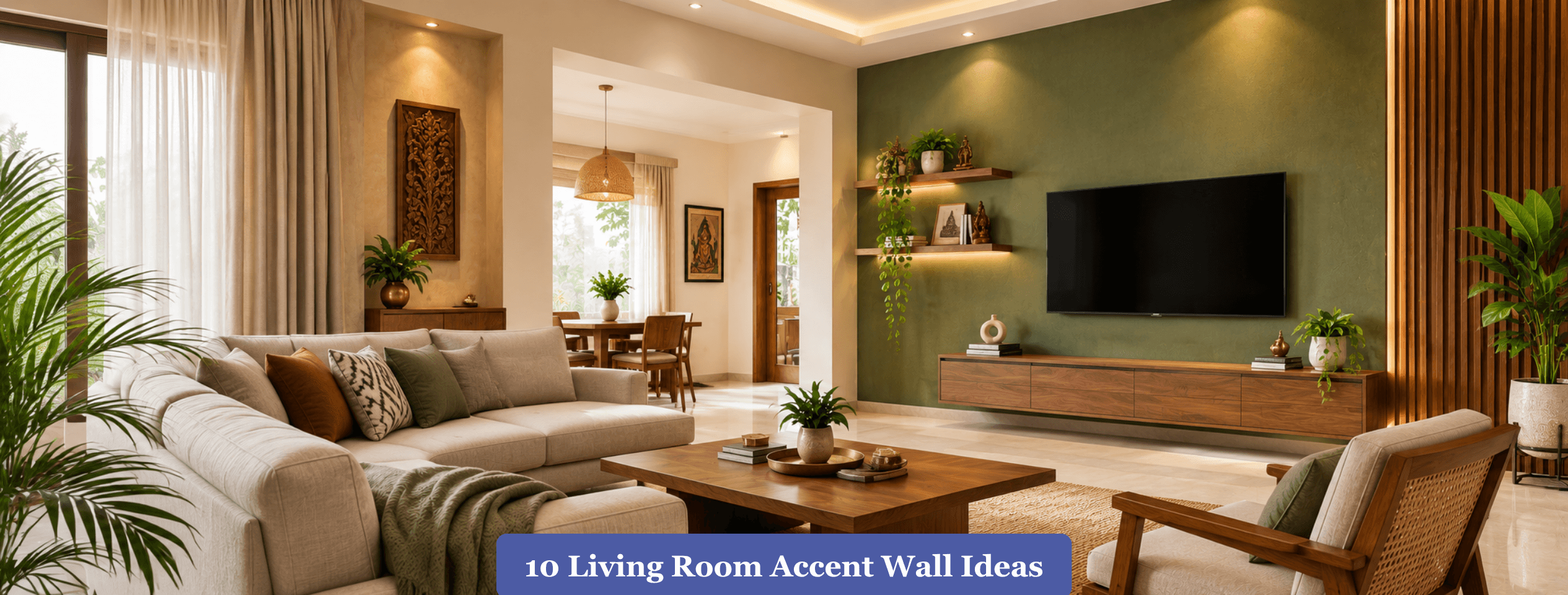
Committing one wall to a saturated colour, deep blue, bottle green or a warm terracotta, remains the fastest and cheapest way to change how a living room feels. Research from the University of Texas at Austin's interior design program, led by Dr. Nancy Kwallek, found that cooler tones such as blue & green support sustained focus and calm for most people, while very bright, high arousal colours work only for those who can mentally screen out visual noise. For an Indian living room, this translates into a practical rule, place the bold colour on the wall receiving the least direct afternoon sun, since strong light on a saturated hue can make a room feel hotter than it actually is, both visually and in the way people describe the room afterward.

Kota, slate or sandstone cladding behind a television unit gives a living room genuine weight and works well in double-height or open-plan layouts. Before specifying it, we always check the wall's load-bearing capacity, since stone veneer adds real weight per square foot compared to paint or laminate. Rougher-finish stones are harder wearing but more porous, which means they need periodic sealing in humid regions to prevent staining, while a honed finish is easier to clean but shows scratches more readily over time.

Wallpaper remains one of the few accent options that is fully reversible, which makes it the right call for rented homes or for anyone who expects to redecorate within five years. Its biggest dependency is wall preparation, any unevenness in the plaster telegraphs through the paper once it is up, so the wall needs to be skim coated and fully dry first. In cities with high ambient humidity, we specify vinyl coated or washable wallpaper rather than paper-based stock, since ordinary wallpaper can lift at the seams within a single monsoon.

Thin brick veneer tiles give the loft aesthetic that is common in reference images from cooler, drier climates, but it needs adjustment for Indian conditions. The wall should ideally face north or east, where it gets diffused light rather than direct heat, and the grout should be a lighter shade than the classic dark grey, because dark grout shows dust accumulation far faster in cities with high particulate air. It is a strong option for a compact living room where the goal is texture without adding visual weight the way stone cladding does.

A mirrored or fluted glass accent wall is a functional choice, not just a decorative one, in the apartment sizes most urban Indian buyers are working with today. Knight Frank India's affordability research has tracked home sizes shrinking by close to a quarter in cities like Mumbai over the past decade as developers optimize for price per unit rather than area. In a compact living room, a mirror wall placed opposite a window, rather than opposite the seating, doubles the perceived depth of the room without the glare problem you get when it faces a light source directly. The limitation to flag upfront in homes with young children is edge safety, so we always specify bevelled or framed edges rather than raw mirror joints.

A fabric-wrapped or fluted acrylic panel with LED backlighting suits contemporary, minimal living rooms and pairs naturally with home automation, since the light behind it can be dimmed or colour-tuned from the same panel controlling the rest of the room. This idea has more moving dependencies than any other on this list, it needs an electrician on site at first fix stage to route wiring behind the panel, not after, and a dimmable driver rated for the LED strip chosen, or the light will flicker within a year. Done well, it becomes the one wall in the house that changes mood between a daytime living room and an evening one.

A wall built around shallow display niches, open shelving or a gallery of framed art earns its place by doing two jobs at once: storage and visual focus. It is the most budget-friendly option on this list and the easiest to execute in phases, which suits a lot of ongoing home projects. Its success depends entirely on restraint in styling. A shelving wall with too many objects reads as clutter rather than as an accent, so we usually plan the layout with roughly a third of the shelf space left intentionally empty.
The right choice among these comes down to three questions we ask on every project, how much natural light does the wall get through the day, how much weight or wiring change can the wall actually support, and how long does the client expect to live in the space before the next renovation. A rented apartment favours wallpaper or paint. A long-term family home can justify stone or lime plaster. A compact city apartment usually benefits more from a mirror or a shelving wall than from anything that adds visual weight. We go into this kind of room by room decision making, beyond just the accent wall, in our broader guide to interior design ideas for Indian homes, which is worth reading before you finalise a colour or material.
Most of the accent walls we execute end up being one part of a larger conversation about how a living room is laid out, lit and furnished, which is why we walk every client through the full room first rather than starting with a swatch. If you are planning this for a home in Coimbatore, our team at R Space works through exactly this sequence as part of our interior design service in Coimbatore, from the first site measurement to the final finish.
Usually the wall, the seating faces, or the one visible immediately from the main entrance, since that is what sets the first impression of the room. Avoid the wall with the main window, as an accent finish there gets partially hidden by curtains and competes with daylight rather than being defined by it.
It can work if the wall receives strong natural light for part of the day and the rest of the room stays light in colour. In a small room with limited daylight, a dark wall on all sides makes the space feel smaller, so it is safer to keep the dark tone to one wall and pair it with lighter flooring and ceiling.
A painted colour block is the easiest to maintain and the cheapest to redo if you change your mind. Textured finishes like lime plaster or stone look richer but need more careful cleaning, since scrubbing textured or porous surfaces too hard can wear down the finish faster than a flat painted wall.
Yes, but only if they do not visually compete for the same focal point. A common approach we use is pairing a textured or coloured wall behind the sofa with a simpler shelving or gallery wall on an adjacent side, so the room has one clear primary focus and one secondary one.
An accent wall itself rarely moves resale value in a measurable way, but a well-finished, well-maintained interior does help a home show better during viewings and can shorten the time it stays on the market. Neutral, well-executed choices tend to appeal to a wider set of buyers than a highly personal colour or material.