
Mr. K.C. Kailasam - 17 Aug 2026
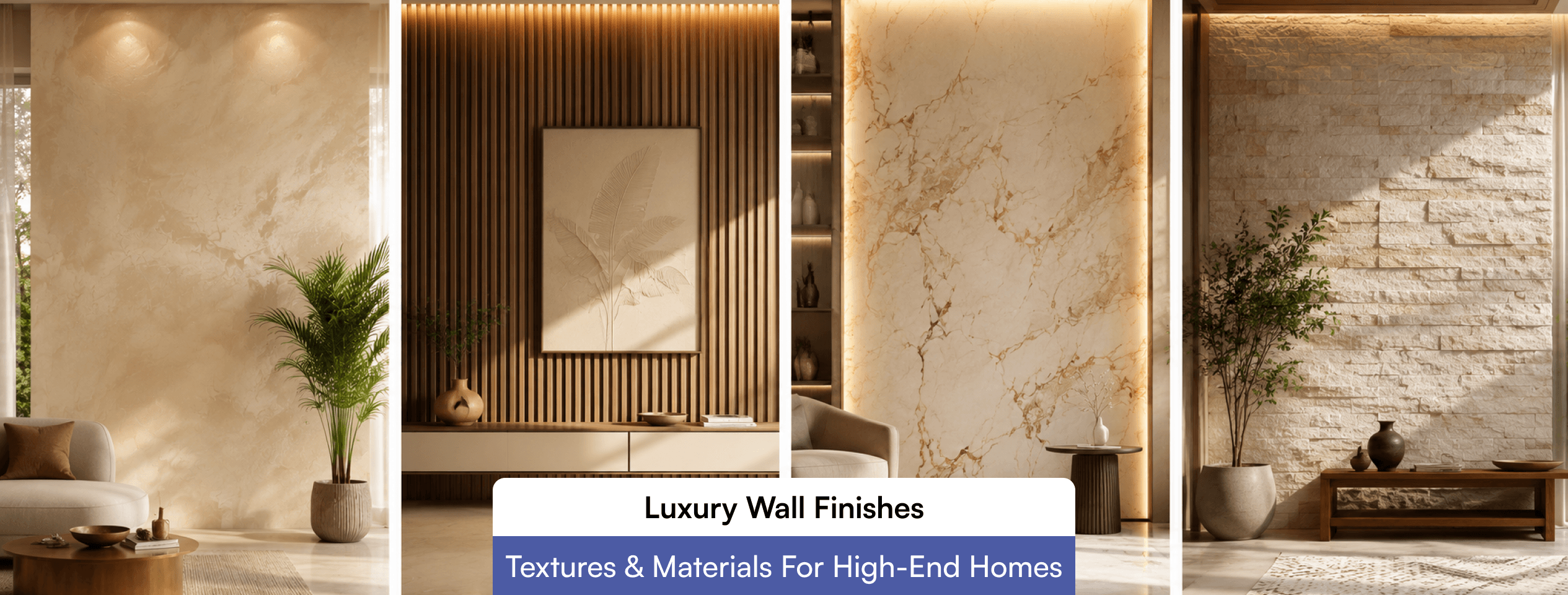
Walk into a home where the walls were specified with real intent, and the difference registers before you consciously notice it. Light moves differently across a hand burnished lime plaster than it does on painted gypsum board. A bookmatched marble panel reads as one continuous vein even from the far end of a twenty foot living room. That is the actual definition of a luxury wall finish. It changes how a room feels to stand in, not just how it looks in a photograph.
Most guides on this subject list materials and stop there: marble, plaster, veneer, wallpaper. What they leave out is the part that decides whether a finish still looks premium in ten years or starts showing seams and stains within two: substrate preparation, humidity behaviour, applicator skill, and how each material ages under daily household use. Across several hundred high-end residential projects, that gap between material selection and execution detail is where almost every client complaint actually originates.
A luxury wall finish combines three things that ordinary paint or laminate cannot. Material depth, the way light penetrates and reflects off a translucent or veined surface, hand craftsmanship, since no two panels or plaster passes are identical, and limited scalability, because skilled applicators and quarried or sourced material cannot be produced overnight. This combination is why a Venetian plaster wall or a bookmatched onyx panel commands both a higher price and a longer design conversation than a coat of premium emulsion.
These finishes depend on conditions most homeowners never see: a flat, fully cured substrate, controlled ambient humidity during application, and lighting design planned around the finish rather than added afterward. A stone feature wall lit by a single downlight looks flat. The same wall with a grazing light fixture mounted close to the surface reveals every vein and crystal structure in the stone. For homeowners looking for a finish tailored to their space, working with custom interior designers in Coimbatore can help align wall materials, lighting, proportions and craftsmanship with the overall interior design. For a broader look at how wall, floor and surface materials work together across a home, our luxury interior materials guide covers the selection logic in more depth.
The category is also growing fast enough that supply and skilled labour are becoming genuine constraints. The global luxury interior design market was valued at close to USD 72.7 billion in 2025 and is projected to grow at roughly 5 percent a year through 2033, with residential projects accounting for close to 38 percent of category revenue. That growth is pulling demand for artisanal plasterers, stone fabricators and veneer specialists faster than training pipelines can fill it, which is part of why sourcing a skilled applicator now matters as much as sourcing the material itself.
Marble remains the reference point for luxury wall cladding because of its veining and the way it takes a polish without losing depth. As a wall finish it is typically applied as 15mm to 18mm slabs on a mechanically anchored or adhesive-fixed system, bookmatched so adjoining panels mirror each other's vein pattern. Its main limitation is porosity, unsealed marble stains from oil, hard water and prolonged steam exposure, which is why the choice between marble varieties matters as much as the decision to use marble at all. We cover that selection process directly in our guide to choosing the best marble for luxury homes.
Travertine offers a warmer, more matte alternative with natural pitting that can be left open for a rustic, tactile finish or filled and honed for a smoother contemporary look. It behaves differently from marble in humid, high-temperature climates common across most of India, where filled and sealed travertine holds up considerably better than unfilled stone exposed to monsoon humidity swings. We compare the two stones directly in Italian marble versus travertine, and go deeper into climate-specific behaviour in our travertine guide for Indian climate and lifestyle.
Onyx is the one natural stone genuinely built for backlighting. Cut to 15mm to 20mm and backed with a resin-reinforced fiberglass mesh for structural stability, it is mounted over an LED panel system so light through the stone reveals its internal banding. This is a dependency-heavy finish: it needs a dedicated lighting design, a recessed wall cavity for the LED array, and a fabricator experienced with resin backing, or the panel risks cracking under its own weight. Our dedicated piece on onyx marble wall design for luxury interiors walks through the lighting and structural planning in detail.
Limestone sits at the calmer end of the natural stone spectrum, usually finished honed rather than polished, which suits minimalist and Mediterranean influenced interiors better than high gloss marble. It is softer than marble, which makes it easier to fabricate into large format panels but more vulnerable to scratching in high-traffic corridors. The structural and maintenance trade-offs between the two stones are laid out in our limestone versus marble comparison.
Regardless of which stone is chosen, wall cladding above a certain size carries real structural implications. Industry guidance referenced by the Natural Stone Institute points to a minimum stone thickness of roughly 1 1⁄4 inches for mechanically anchored veneer systems, and similar engineering discipline applies to large interior panels, which is why stone cladding decisions should involve a structural check and not just a material selection.
Venetian plaster is a lime-based finish applied in multiple thin coats and burnished with a steel trowel until it develops a soft, marble-like sheen. It has no seams, no grout lines and no repeating pattern, which is exactly why it reads as more expensive than most stones. The entire wall is one continuous surface. The trade off is skill dependency. Each coat needs 24 to 48 hours to cure before the next pass, the wall underneath must be flat within a few millimetres, and an inexperienced applicator produces visible trowel marks that no amount of touch-up can fully hide.
Microcement is a thinner, more waterproof cementitious coating suited to wet walls, shower enclosures and kitchen backsplashes where Venetian plaster would fail. It resists cracking over minor substrate movement better than lime plaster but does not develop the same depth of patina over years of use. Choosing between the two comes down to location and long-term maintenance appetite, which we break down fully in microcement versus Venetian plaster.
Fluted timber panels and bookmatched veneer sheets bring warmth and acoustic softening that hard stone and plaster cannot. The critical dependency here is moisture acclimatisation: timber and veneer panels need seven to ten days stored inside the finished, climate-controlled room before installation, or they gap and cup within months as they adjust to indoor humidity. Grading and cut selection matter just as much as species; our guide to premium veneers for wardrobe and furniture finishes applies equally to wall panelling specification.
Wall panelling reads strongest when its tone is coordinated with the flooring rather than treated as a separate decision. A rift cut oak panel wall paired with flooring from the same species family, the kind of pairing covered in our oak hardwood flooring guide, produces a noticeably more cohesive room than mixing unrelated wood tones.
Brushed brass and bronze inlay strips, upholstered leather panels and hand-troweled metallic mineral plasters occupy the boldest end of the category. These are used deliberately in small doses, a bar backsplash, a study accent wall, a powder room, because their visual intensity does not suit large uninterrupted surfaces the way stone or plaster does.
Fabric wallcoverings, typically silk, linen or wool blends mounted on padded battens rather than pasted directly to the wall, do something none of the hard finishes can: they absorb sound. This is a detail most articles on wall finishes skip entirely. In a home theatre, a formal study, or a primary bedroom backing onto a busy street, a padded fabric wall measurably reduces echo and street noise transfer in a way marble or plaster physically cannot, since hard, reflective surfaces bounce sound rather than absorb it.
Material selection has to start with climate, not aesthetics. In a coastal or high-humidity region, unsealed natural stone and open-pore lime plaster both perform worse over five years than in a dry climate, because moisture cycling through the material accelerates staining and micro-cracking. Engineered veneer, manufactured with cross-layered construction rather than solid timber, holds its dimensions far more reliably than solid wood panelling in these conditions; we explain the construction difference in our engineered wood flooring guide, and the same stability logic applies directly to wall applications.
Room function matters as much as climate. A powder room or bar area can absorb a bold onyx or leather finish because it is used briefly and by fewer people. A primary bedroom or living room, used daily for hours, benefits more from a calmer honed limestone or a Venetian plaster in a warm neutral, since high-contrast veining becomes visually fatiguing in spaces occupied for long stretches.
None of this is a catalogue decision. It depends on the specific wall's orientation to natural light, the room's acoustic needs, and how the household actually uses the space, which is why every material decision should be walked through a physical mockup under the site's own lighting before anything is ordered. If you are planning this for a home in Coimbatore, our interior design service for Coimbatore homes covers how we run that process end to end.
Natural stone, lime plaster and microcement are inherently low emission once cured, since they do not rely on solvent based binders. Painted finishes, lacquered veneer and some fabric adhesives do, and this is where indoor air quality becomes a real specification issue rather than a marketing line. In the United States, the EPA's architectural coatings VOC standard sets maximum volatile organic compound content for interior coatings, and stricter third-party certifications cap flat paints at 50 grams per litre. Specifying low-VOC primers and topcoats on veneer and painted trim, and allowing adequate cure and ventilation time before a room is occupied, particularly nurseries and bedrooms, is a detail worth insisting on regardless of which finish carries the wall.
Labour, not material, is usually the larger line item in a luxury wall finish budget. A Venetian plaster wall can cost more per square foot than a mid-range marble slab once you account for the multiple coats, burnishing time and the applicator's day rate. Maintenance cadence also varies sharply: sealed marble and travertine typically need resealing every twelve to eighteen months in daily-use areas, Venetian plaster needs an occasional wax reapplication rather than resealing, and veneer mainly needs protection from direct UV exposure and humidity swings rather than active maintenance.
Budgeting for the applicator's skill level and the maintenance calendar upfront avoids the most common source of post-handover disappointment: a finish that looked perfect at handover and started degrading within a year because nobody planned for its upkeep.
Skipping a physical mockup panel under the room's actual lighting, then being surprised when the finish looks different from the showroom sample.
Ignoring substrate movement joints, especially where plaster or microcement crosses a structural expansion joint, which leads to hairline cracks within the first year.
Underbudgeting for skilled labour and hiring on material cost alone, the single biggest driver of visible trowel marks and uneven veining.
Mixing too many high-contrast finishes, marble, onyx and metallic plaster, in one room, which competes for attention instead of creating one strong focal point.
Sequencing wet finishes like plaster after electrical and lighting fit-out instead of before, which risks damaging the finish during later trade work.
A luxury wall finish is a decision about how a room performs over the next decade, not just how it photographs at handover. The material choice matters, but the substrate preparation, the applicator's skill, the lighting plan and the climate-specific detailing decide whether that decision holds up. Our team at R Space has run this specification process across several hundred high-end homes and can walk you through what will actually hold up in your specific space.
Sealed natural stone, particularly honed granite or well-sealed marble, generally outperforms plaster and fabric in corridors and stairwells because it resists scuffing and impact better than softer finishes. Venetian plaster and microcement are close behind for durability but need a skilled applicator's repair if damaged, since patch repairs on a monolithic surface are visible unless done by the original installer.
Yes, with the right preparation. Venetian plaster is breathable and manages ambient moisture reasonably well, but it needs proper wall priming, controlled curing time between coats, and a finishing wax layer in bathrooms or kitchens to resist moisture absorption. It performs less reliably in direct wet zones than microcement.
Luxury finishes typically run several times the cost of premium emulsion paint once labour is included, since materials like stone cladding and hand-applied plaster involve skilled trades billed by the day rather than a one-time material and application cost. The exact multiple depends heavily on the specific finish, room size and local labour rates, so a site-specific quote is more reliable than a general benchmark.
Yes, but both need to be properly sealed and, for onyx, backed with resin reinforcement, since bathroom humidity and standing water accelerate staining on unsealed stone. Ventilation matters as much as the sealant, since trapped moisture behind the panel can cause staining that shows through even sealed stone over time.
The decision usually comes down to acoustics, warmth and the room's existing material palette rather than which material is objectively better. Wood panelling softens sound and pairs naturally with warm metals, while stone cladding creates a cooler, more formal focal point and works better in double-height spaces where its scale reads clearly.