
Mr. K.C. Kailasam - 11 Aug 2026
Most clients who ask us for a Mediterranean interior are not describing a colour scheme. They are describing a feeling they experienced somewhere else, a villa in Crete, a courtyard hotel in Marrakesh, a farmhouse on the Amalfi coast, and they want that same calm translated into a home in Chennai, Coimbatore or Kochi. The difficulty is that most reference images come from a dry Mediterranean climate, while South India deals with intense monsoon humidity, harsher tropical sun, and building materials sourced from an entirely different supply chain. Getting the look right means understanding why Mediterranean design developed the way it did, and then re-engineering it, material by material, for a climate it was never originally built for.
Mediterranean interior design is not one national style. It is a family of building traditions shaped by the coastlines of Greece, Italy, Spain, southern France and Morocco, all of which share a common design brief: keep interiors cool under strong sun, let air move freely, and blur the line between indoor and outdoor living. That shared climatic problem, not a shared aesthetic preference, is what produced thick plastered walls, small deep-set windows, shaded courtyards, terracotta roofing and stone flooring across such a wide geographic spread.
The style is often reduced online to blue shutters and whitewashed walls, which is really the Greek island subset of a much larger tradition. Italian Mediterranean leans on ochre plaster and terracotta. The Spanish Mediterranean brings in wrought iron and glazed tilework with Moorish influence. Moroccan coastal interiors add carved wood, zellige tile and richer colour. If you want a broader map of how this compares with other interior styles before committing to one, our overview of home interior design styles is a useful starting point.
South India and the Mediterranean coast share more than warm weather. Both regions developed vernacular architecture around thick walls, high ceilings, courtyards and cross ventilation, because both were solving for heat before mechanical cooling existed. This is why Mediterranean detailing sits naturally on a South Indian villa in a way it would not on a home in a cold, dry climate. Lime plaster, one of the defining Mediterranean wall finishes, has measurable thermal benefits that matter directly in this context.
A controlled study comparing lime-plastered and cement-plastered test cells found the lime-plastered room stayed 3 to 5 degrees Celsius cooler and remained within comfortable temperature range roughly 40 percent more of the time, largely because lime buffers moisture and releases absorbed heat gradually rather than trapping it (ScienceDirect). For a villa in a state that runs cooling systems for eight to nine months a year, that is not a decorative detail, it is a performance argument for choosing lime-based finishes over cement-based ones.
Mediterranean design was refined for a dry climate, and South India is not dry. Lime plaster, limestone flooring and untreated iron all behave differently once monsoon humidity enters the picture. Lime needs a breathable topcoat rather than a sealed acrylic paint, natural stone needs anti-skid honing and proper slope for water drainage in courtyards, and iron fixtures need marine-grade powder coating or they will show surface rust within two monsoons on the Tamil Nadu and Kerala coastline. Any Mediterranean brief for this region has to be written by someone who has actually detailed a monsoon-facing courtyard, not someone reproducing a Santorini mood board.
Authentic Mediterranean interiors read as textured and handmade rather than machine-finished. Five materials carry most of that language, and each has a local sourcing path that keeps the look genuine without importing everything at European prices. For homeowners planning this style locally, experienced interior designers in Coimbatore can help balance Mediterranean detailing with materials, climate conditions and practical South Indian living.
Purpose: breathable wall finish that softens light and ages with a visible patina rather than showing cracks.
Advantage: superior thermal buffering, discussed above, plus a hand-applied texture that flat paint cannot replicate.
Limitation: requires a skilled applicator, since uneven lime work looks unfinished rather than rustic. It depends on correct curing time and a compatible mineral-based topcoat, and it should never be sealed with plastic-based paint, which traps moisture behind the surface.
Terracotta flooring is a Mediterranean signature, and Tamil Nadu already has its own handmade equivalent in Athangudi tiles from Chettinad, cast by hand using glass-sheet moulds. Using Athangudi patterns in earthy, sun-baked tones gives a villa genuine terracotta warmth with materials and artisans already local to the region, which also shortens lead time compared to importing Italian or Moroccan tile. This pairs well with the layered, natural-material approach covered in our piece on organic modern interior design.
Purpose: flooring, countertops and courtyard paving that read as quarried rather than manufactured. Rajasthan supplies limestone and sandstone in Mediterranean-adjacent tones, and Kota stone offers a cooler, more budget-conscious alternative for larger floor areas.
Limitation: porous stone needs sealing against oil and monsoon staining, and light-coloured stone shows footfall wear faster in high-traffic zones like kitchens.
Iron carries the Spanish and Moroccan thread of the style through window grilles, stair railings, pendant lights and courtyard gates. Reclaimed teak, common in older Tamil Nadu and Kerala homes as beams and door frames, gives ceilings and furniture the weathered depth Mediterranean interiors rely on. The dependency to plan for is finishing, powder coated or oil blackened iron survives coastal humidity, raw mill finish iron does not.
Mediterranean colour stories are built from what the local landscape offers: sun-bleached limewash walls, terracotta roofing, olive and cypress greens, and the saturated blue of the Aegean Sea used sparingly as an accent, usually on a door or shutter, never across an entire room. The base palette of warm sand, ivory, ochre and clay works directly in South Indian light.
The adjustment that matters is intensity. Aegean light is diffuse and slightly cool, while Chennai or Madurai sun is harsher and yellower. A blue that looks soft and chalky on a Greek island can look artificial and cold under Tamil Nadu daylight. We generally shift the accent blue warmer, toward a muted teal or slate, and lean more heavily on the ochre and terracotta side of the palette so the room feels sun warmed rather than imported. This restraint is the same principle behind the tonal layering we describe in warm minimalist interior design, even though the material language here is more textured.
The strongest link between Mediterranean architecture and South Indian tradition is not decorative at all, it is spatial. The Mediterranean courtyard villa and the Tamil nalukettu or Kerala naalukettu, a home built around a central open to sky courtyard, solve the same problem: pull light and air into the centre of a deep floor plate while keeping the perimeter shaded. A Mediterranean-inspired villa in South India is often less about importing a foreign layout and more about reviving a courtyard logic the region already had, dressed in different material finishes.
Arched openings between living and dining zones read as Mediterranean while also improving cross ventilation between rooms
A shaded verandah or pergola along the courtyard edge does double duty as outdoor living space and as a heat buffer for the rooms behind it
Jaali or lattice screening, already common in Indian residential architecture, filters harsh sun the way Mediterranean pergolas and louvred shutters do
Arches and proportions also connect this style to more formal European references. If a client wants a slightly grander, more symmetrical version of this vocabulary rather than a rustic one, our guide to neo classical interior design covers where the two approaches diverge.
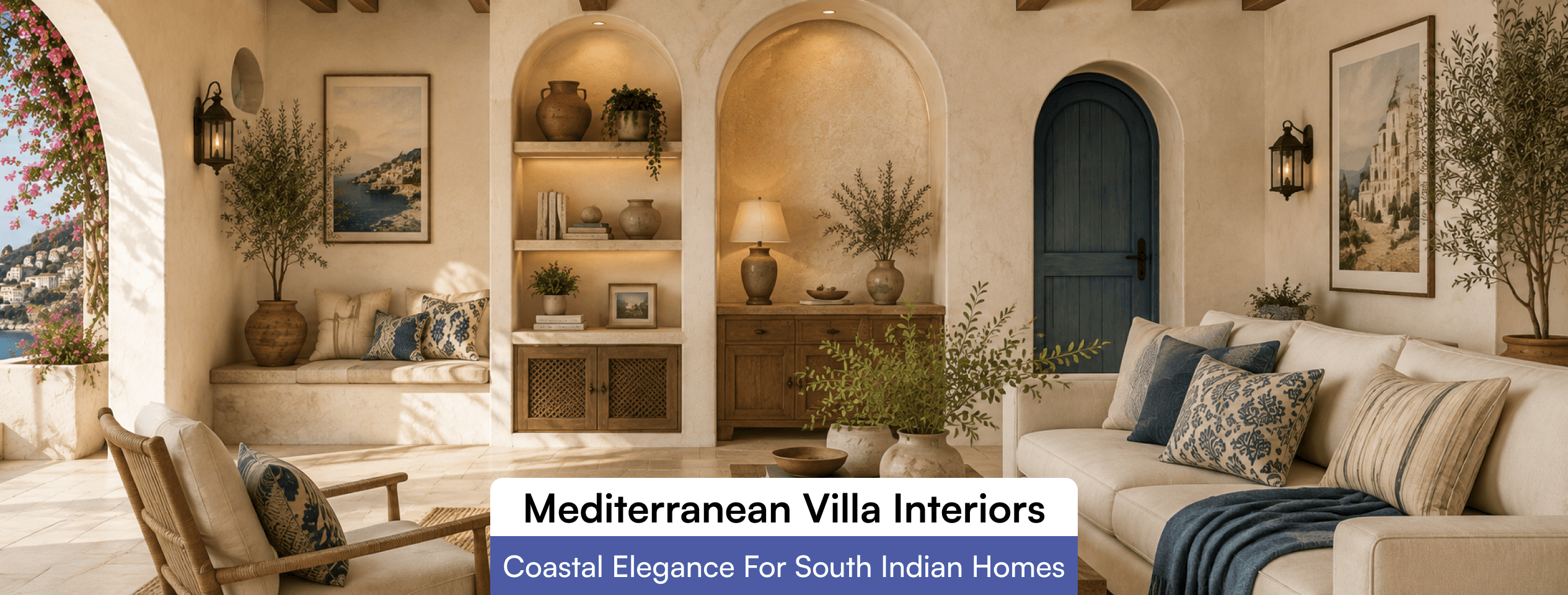
Exposed wood beams, a lime-plastered feature wall, and a wrought iron chandelier over the dining table do most of the work here. Furniture should stay low and solid rather than ornate, since Mediterranean interiors read as lived in rather than showcased. Woven rattan and linen upholstery keep the room breathable in humidity.
A handmade tile backsplash, either Athangudi or a zellige inspired pattern, paired with honed stone counters and open wood shelving gives the kitchen its Mediterranean identity without sacrificing daily practicality. Keep the tile pattern to the backsplash and one accent zone. Covering every surface in pattern is the most common overcorrection we see in reference images pulled from Pinterest.
Terrazzo flooring, an arched mirror niche, and a single band of hand-painted tile around a stone basin create the effect at a fraction of the cost of tiling an entire bathroom in imported pattern work. Waterproofing detail around stone thresholds needs extra attention in a monsoon climate, since this is where lime and natural stone finishes fail first if the substrate work is rushed.
Garden blooms and citrus plants stand in well for the olive and cypress plantings of the original style, since they tolerate South Indian heat and humidity far better. A pergola in reclaimed wood or powder coated iron, with terracotta or natural stone paving underfoot, is usually the single element that makes the rest of the interior feel connected to an authentic Mediterranean villa rather than a themed room.
Treating it as a colour scheme instead of a material and spatial system, which results in a blue-and-white room that still feels generic
Sealing lime plaster with the wrong topcoat, which traps moisture and causes peeling within a monsoon season or two
Skipping slope and drainage detailing on courtyard stone paving, leading to water pooling that no amount of good design can hide
Sourcing every material internationally, which inflates cost and timeline when a comparable local material, like Athangudi tile in place of terracotta, would serve the same purpose
This last point overlaps with a broader lesson we repeat across styles, the goal is quiet, durable craftsmanship rather than an obviously expensive material list, a principle we go into further in quiet luxury interior design.
Demand for themed and character driven interiors, Mediterranean, European and ethnic Indian among them, has been rising steadily as more Indian homeowners move past purely functional decor (PS Market Research). India's interior design market itself has grown into a roughly USD 31 to 37 billion industry as of 2025, expanding at a double-digit compound rate, which has widened the pool of artisans and material suppliers now working with lime, natural stone and handmade tile, even outside the metros (Mordor Intelligence).
What this means practically for a villa project, hand applied lime plaster and custom ironwork are labour intensive and should be scheduled early, since good artisans book out weeks in advance. Tile work with patterns, whether Athangudi or zellige style, needs longer lead time than plain ceramic tile because of the hand-finishing involved.
Budgeting realistically means treating three to four elements, lime-plastered walls, a courtyard or verandah pergola, statement ironwork, and a tiled feature zone, as the investment areas, and using simpler, well-detailed finishes everywhere else rather than spreading the Mediterranean treatment thin across every surface in the house.
At R Space, a Mediterranean brief starts with the site, not the mood board. We assess sun orientation, monsoon exposure and existing courtyard potential before deciding how far to push lime plaster, stone flooring or exposed wood, because a west-facing courtyard in Coimbatore needs different shading and material decisions than a shaded internal courtyard in Kochi.
Our approach draws on both Mediterranean material logic and the passive cooling techniques already embedded in South Indian vernacular building, so the villa performs well through the year, not just in photographs taken during a mild week. If you are exploring this for a home in the region, our home interior designers in Coimbatore team can walk through site-specific feasibility before any material is finalised.
Mediterranean interior design works in South India because both traditions were solving the same climate problem long before air conditioning existed. The reference images are useful for colour and texture, but the execution has to be rebuilt around monsoon behaviour, local artisanship and the courtyard logic South Indian homes already understand. Done this way, the result reads less like an imported theme and more like a home that was always meant to be built this way. For a wider comparison of how this style sits against other design directions we work in, see our overview of home interior design styles.
Yes, with adaptation. The style's core materials, lime plaster and natural stone, were developed to manage heat, which suits South India. The adjustment needed is for humidity rather than dryness: breathable topcoats on lime, proper drainage on stone paving, and marine-grade finishes on iron and metal fixtures to prevent monsoon damage.
Lime plaster or limewash walls, terracotta or handmade tile flooring, natural stone such as limestone or sandstone, wrought iron fixtures, and reclaimed or exposed wood beams. In South India, Athangudi tile and Rajasthan stone are commonly used as local, faster-to-source equivalents to imported terracotta and European limestone.
Santorini style is a narrow subset, white walls with blue accents, drawn from Greek island architecture alone. Broader Mediterranean design also includes Italian ochre plasterwork, Spanish wrought iron and glazed tile, and Moroccan carved wood and zellige. Coastal design, as used in Western interior marketing, usually refers to a nautical, beach-house aesthetic with rope and stripe motifs, which is a different visual language altogether.
Cost depends heavily on how much of the material list is imported versus locally sourced. Using Athangudi tile instead of imported terracotta, Rajasthan or Kota stone instead of imported limestone, and locally fabricated ironwork keeps the style achievable at a mid to upper mid-range residential budget. Costs rise quickly if every finish is sourced internationally rather than adapted using regional equivalents.
Yes, and it usually works better that way than as a full period recreation. Most modern villa projects apply Mediterranean language selectively, a lime-plastered feature wall, an arched courtyard opening, terracotta flooring in key zones, wrought iron detailing, rather than replicating an entire European villa. This keeps the home functional for contemporary Indian living while carrying a clear, coherent design identity.