
Mr. K.C. Kailasam - 13 Aug 2026
When first-time homeowners walk into our studio, they usually bring reference images from four or five different aesthetics and expect us to merge all of them into one identity for their new home. After executing projects across apartments, villas and duplexes, we have noticed a pattern that most style guides never mention: the images people save are rarely about the style itself. They are about how the room made them feel. A tidy foyer feels like control. A textured living room feels like warmth. That feeling is the real brief. The style name gets attached to it later, usually by an algorithm.
This response to feeling over form is backed by research. A survey commissioned by Redfin found that 74 percent of homeowners describe their home as a reflection of who they are, and the same share said they would rather be home than anywhere else. Interior style, in other words, is not decoration. It is identity management for the place you spend most of your life. For a first-time homeowner making decisions with a fixed budget and a home you likely won't renovate again for years, getting that identity match right the first time matters more than following what is trending in a magazine.
Saved images are curated by what performs well on a screen, not by how a room functions for the person living in it. We once worked with a client who had saved dozens of all-white minimalist interiors, yet she cooked South Indian meals daily, had two dogs, and needed visible, reachable storage rather than closed cabinetry. The mismatch was never aesthetic. It was behavioural. Within four months of moving in, an all-white kitchen with no open shelving would have created daily friction, not calm. The lesson we apply on every project is simple: a style has to survive contact with your actual week, not just your saved folder.
If you want the full landscape of design languages before narrowing down, our guide to home interior design styles covers the broader vocabulary. This article works differently. It starts from you, not from the style, and works backward to the room.
Before assigning a client a style name, we ask about their week, not their wall art. Five behavioural cues consistently predict which direction a home should take, and almost none of the generic style quizzes online ask about them.
How you keep your wardrobe. Folded and hidden points toward a structured, minimal palette. Displayed and layered points toward a warmer, more expressive scheme.
How you react to visible wires and clutter. Genuine irritation signals a need for concealed storage and clean lines. Indifference signals room for texture and layering.
What your evening actually looks like. Quiet reading nights favour softer, enclosed spaces. Frequent guests favour open sightlines between kitchen, dining and living areas.
How you feel about inherited or aged objects. Comfort with imperfection and family pieces points toward warmer, storied interiors. A preference for everything new points toward cleaner, contemporary schemes.
Your tolerance for visual busyness. Some people find patterned surfaces energising. Others find them exhausting by the second week. Neither is wrong, but the mismatch is expensive to reverse.
None of these questions have a right answer. They simply narrow the field before you spend money on furniture that photographs well but does not fit how you actually live.
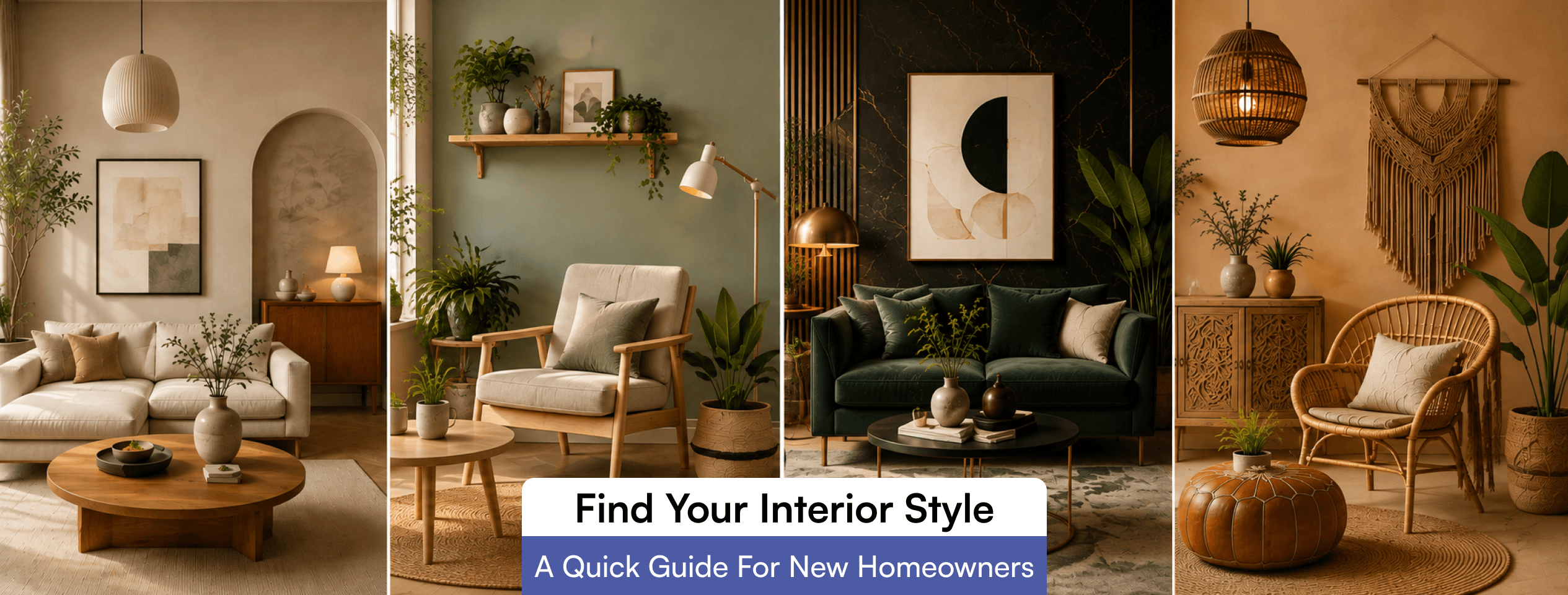
Once we know how a client actually lives, we map that behaviour to a design language with a clear identity, not a loose mood. Each of the following pairs a personality tendency with a style that consistently suits it, along with where it tends to work best and where it struggles.
If clutter genuinely unsettles you and you prefer a function stated plainly, warm minimalism is usually the right direction. It keeps a minimalist's restraint on form while adding timber tones, linen textures and warm lighting so the space does not feel clinical. It depends heavily on disciplined storage design, since every surface stays visible. The limitation is that it offers little room for sentimental clutter, so it suits people who genuinely enjoy editing their belongings rather than those who feel pressured into it.
For personalities who want order but also warmth and a sense of ritual, Japandi blends Japanese restraint with Scandinavian comfort. It rewards natural materials, low furniture lines and soft, indirect lighting. Its dependency is craftsmanship quality, since the style has few decorative elements to hide average joinery. If you are deciding between this and its closer cousin, our comparison of Scandinavian and Japandi styles breaks down where the two genuinely diverge.
Personalities who avoid visible status symbols but still want a home that reads as considered tend to gravitate toward quiet luxury. The style leans on material quality over branding, using stone, brushed metal and tailored upholstery instead of ornamentation. Its main limitation is budget elasticity. Because the effect depends on material honesty rather than decoration, cutting corners on finishes is far more visible here than in a more layered style.
If you feel calmer around plants, natural light and unfinished textures, organic modern design balances sleek, contemporary forms with raw materials like cane, stone and reclaimed wood. It depends on genuine daylight access, since the palette is muted and needs sunlight to stay from reading dull. This makes it a strong fit for homes with good cross ventilation and a weaker fit for deep, window-poor apartment layouts.
Personalities comfortable with contrast and a bit of visual friction often respond to industrial luxury, which pairs raw concrete, exposed metal and moody lighting with tailored furniture to keep the look from feeling unfinished. A softer alternative for the same personality is urban modern design, which keeps the confidence but trades raw texture for cleaner architectural lines. Both depend on strong structural planning early in the build, since exposed elements are far harder to retrofit than to plan from day one.
If ornamentation, symmetry and a sense of formality feel comforting rather than fussy, neo-classical interiors suit that instinct well, using classical proportions, mouldings and a restrained colour palette. The dependency here is ceiling height and room proportion, since the style's detailing needs scale to avoid feeling heavy. It works best in villas and independent houses more than compact apartments.
Personalities drawn to warmth, texture and an outdoor-indoor rhythm often suit Mediterranean interiors adapted for South Indian villas, which uses lime-washed walls, terracotta and arched openings. Its biggest advantage in our climate is that the materials are naturally suited to heat and humidity. Its limitation is that it needs generous outdoor or semi-outdoor space to feel authentic rather than decorative.
If you would rather live with honest imperfection than chase a flawless finish, wabi-sabi design embraces irregular textures, handmade objects and visible age as part of the beauty rather than a flaw to hide. It depends on client patience during execution, since artisanal finishes rarely look uniform, and that is intentional. It is a poor fit for personalities who equate luxury with symmetry and polish.
Personality narrows the field, but four practical dependencies decide what is realistic for your specific home. Climate and orientation determine how much a material-heavy style like Mediterranean or organic modern will perform over years, not just how it photographs on day one. The existing architectural shell, whether it is an apartment with fixed structural walls or an independent villa, decides how much of a style's identity can come from architecture versus surface treatment alone.
The budget tier decides whether a style's character comes from expensive natural materials or from proportion and colour discipline instead, which costs far less to execute well. And maintenance appetite, meaning how much upkeep you are honestly willing to do, decides whether raw or textured finishes will still look intentional two years in, or simply look worn. These considerations are easier to evaluate with an interior design company in Coimbatore that understands local homes, materials and execution requirements.
The budget tier decides whether a style's character comes from expensive natural materials or from proportion and colour discipline instead, which costs far less to execute well. And maintenance appetite, meaning how much upkeep you are honestly willing to do, decides whether raw or textured finishes will still look intentional two years in, or simply look worn. One decision point we get asked about constantly is the difference between modern and contemporary design, since the two get used interchangeably online but behave differently in a floor plan. Our breakdown of modern versus contemporary interior design walks through exactly where that distinction changes your material and furniture choices.
From a project management standpoint, style indecision is the single biggest cause of change orders after construction has already started. It is far cheaper to resolve a style question on paper than to reverse a tiling decision after installation. Industry research reflects this gap between intention and satisfaction. In a Houzz decorating survey of over 1,700 homeowners, only 2 percent felt they had fully achieved their vision for their home, with most estimating they were roughly halfway there.
Separately, Houzz's renovation research found that 32 percent of homeowners choose to renovate rather than move specifically to personalise their space, which confirms that personalisation is not a nice-to-have late in a project. It is one of the primary reasons people invest in design work in the first place, and it works best when it is decided before drawings are finalised, not during site execution.
A separate consumer survey found that 75 percent of homeowners admit some of their past home improvement choices have not aged well, and 69 percent said they feel embarrassed to have guests over because of past aesthetic decisions. Most of these regrets trace back to choosing a style because it was popular rather than because it matched how the household actually lives. That is the exact gap this guide is written to close.
A first home is usually the only home most people fully personalise before their taste has had years to shift, which is exactly why the style decision deserves more structure than a moodboard. If you would rather walk through this with someone who has executed the dependencies above on real sites, our home interior design service in Coimbatore starts with the same behavioural questions covered in this guide before a single drawing is made. You can also explore more of our project thinking at R Space.
Look at your daily habits rather than your saved images. How you store your wardrobe, how you react to visible clutter, how often you host guests and how you feel about inherited objects will tell you more about the right style than any single moodboard. Most people fall clearly into a structured, warm, bold or heritage-leaning tendency once they answer those questions honestly.
Warm minimalism and Japandi are currently the most requested styles among first-time homeowners, largely because both offer a clean, low-maintenance base that can be personalised gradually as budget allows, rather than requiring every decision to be finalised at once.
Yes, and most well designed homes are a blend rather than a pure single style. The key is choosing one style as the dominant language for shared spaces like the living and dining area, then allowing a secondary style to influence private spaces like the bedroom or study, so the home stays cohesive instead of feeling disjointed.
Style choices influence resale less than layout and material quality do, but overly personalised or trend-specific finishes on permanent surfaces, such as bold tile choices, can narrow your buyer pool later. Choosing a timeless base palette and expressing personality through furniture and decor keeps both flexibility and resale value intact.
Costs vary by scope, ranging from a paid consultation for style direction alone to a full design and execution package that covers civil work, furniture and styling. Most first-time homeowners find that a short consultation to lock the style direction early saves significantly more in avoided change orders than it costs upfront.